Hacker Tradecraft · Volume 2
Hacker Tradecraft Volume 2 — History I: Proto-Hacking, 1950s–1970s
From MIT Tech Model Railroad Club model trains to the Cap'n-Crunch whistle and the blue box, the AI Lab's hacker ethic, and the Menlo Park garage where Homebrew handed the microcomputer to the rest of us
Contents
1. About this volume
This volume opens the three-volume history cluster — Vols 2, 3, and 4 — that traces the arc of hacker culture from its prehistory through to the modern threat-and-defense industry. Each volume covers roughly a generation. Vol 2 covers the proto-hacking era: the late 1950s through the 1970s. Vol 31 picks up at the 1980s “golden age” — bulletin-board culture, the 414s, the Morris worm, the Computer Fraud and Abuse Act, the Mitnick saga — and runs into the mid-1990s, where the term “hacker” began its long, contested split into criminal and ethical senses. Vol 4 covers the modern era: the pentest industry, the bug-bounty economy, advanced-persistent-threat operations, and the ransomware-as-a-business landscape of the 2020s. The hat metaphor itself — the white/black/grey vocabulary used throughout this series — gets its archeological treatment in Vol 52, because the metaphor postdates the period this volume covers; in the 1960s and 1970s, nobody was calling themselves a “hat” of any color.
The lens applied throughout is what carried forward into modern tradecraft, not “comprehensive history of the early computer industry.” There are excellent histories of the latter — Levy’s Hackers3, Markoff’s What the Dormouse Said4, Hafner & Lyon’s Where Wizards Stay Up Late5 — and this volume cites them throughout rather than re-deriving them. The reader is assumed to have either read those books or to be willing to follow the footnotes when a detail matters. What this volume does is filter the historical material for the lineage of the craft: what assumptions about computers, networks, authority, and information did the 1950s–70s hackers establish, and which of those assumptions are still operative in the practice of a 2026 penetration tester, threat hunter, or vulnerability researcher? The answer turns out to be more interesting than “all of them, except the legal climate.” Some values transferred cleanly into the white-hat profession (curiosity, peer-judgment-not-credentialism). Some hardened into the black-hat criminal economy (mistrust of authority, “information wants to be free”). Some — the radical openness of the AI Lab — survive today only in narrow pockets and are arguably extinct as an industry default.
A note on framing the figures. Most of the people who appear in this volume — Levy’s protagonists at the MIT AI Lab, John Draper, Steve Wozniak, the Homebrew regulars — are still living or only recently deceased, and many have written their own accounts. Where this volume relates a specific quote, action, or technical detail, it cites a verifiable source. Where the historiography has hardened around a story that may be partially apocryphal (the Cap’n Crunch whistle as the origin of phreaking, the Esquire-to-blue-box hustle as a single causal chain), the volume signals that explicitly rather than asserting it. Hacker history is a folkloric tradition almost as much as a documented one, and writing about it honestly means flagging where the lore outruns the record.
2. Before “hacker” meant computers — TMRC, the TX-0, the PDP-1, Spacewar!
The earliest documented use of the word hack in something close to the modern sense came not from a computer lab but from a model-railroad club. The Tech Model Railroad Club (TMRC) at the Massachusetts Institute of Technology had existed since 1946; by the late 1950s its Signals and Power (S&P) subcommittee was wiring together a sprawling, ever-evolving layout under the club’s central display, using surplus telephone-exchange relays donated by Western Electric to build a control system of genuine engineering ambition6. Hack in the TMRC lexicon meant a piece of work or engineering that altered a system to achieve something the original designers hadn’t anticipated, executed with sufficient ingenuity that it was worth admiring on its own terms — not as a step toward a final product but as an artifact in itself. The TMRC’s posted “Dictionary” recorded this sense, alongside dozens of other club-internal terms, in mimeographed form before any of it appeared in print culture7.
The crucial migration happened when the S&P subcommittee discovered that MIT was running, in Building 26, an early transistorized research computer called the TX-0, on loan to the Research Laboratory of Electronics from Lincoln Laboratory in 19588. The TX-0 had been built around 1956 to demonstrate transistor logic at a time when most production computers were still vacuum-tube — its design eventually informed the DEC PDP-1 — and by the late 1950s was unofficially available to graduate students and the occasional very-determined undergraduate during off-hours, in particular the long stretches between the official users’ batch jobs. The TMRC’s better engineers found their way into the TX-0 room and brought the hack vocabulary with them. The same ethos that valued an elegant relay-and-toggle circuit on the railroad layout transferred almost without translation into the way you wrote a clever program on a 4096-word, 18-bit machine with a CRT display and a paper-tape reader. The TX-0 was, in Levy’s framing, “the first hacker computer”6 — not because it was particularly powerful but because it was accessible to the hands-on imperative (see §5) in a way no batch-processed IBM mainframe of the era was.
The TX-0 was succeeded in the MIT AI Lab around 1961–62 by the DEC PDP-1, a commercial machine descended from the TX-0 design9. The PDP-1 had a paper-tape reader, a Type 30 CRT display, an interrupt system, and — critically — was a single-user interactive machine. You sat at it. You typed at it. It responded. You did not, as on a mainframe, hand a deck of cards to an operator and come back tomorrow for the printout. The PDP-1 is where interactive computing as a hacker activity crystallized, and the canonical artifact of that crystallization is Spacewar!, written in 1961–62 by Steve Russell, Martin Graetz, Wayne Wiitanen, and a handful of others at the MIT AI Lab and TMRC10. Spacewar! was a two-player space-combat game with realistic gravitational physics from a central star, written in PDP-1 assembly and displayed on the Type 30 CRT — the first widely-distributed digital game, distributed informally on paper tape to any other PDP-1 installation that asked. It was a hack in every sense: undertaken for no funded purpose, demonstrating considerable mastery of a difficult-to-program machine, freely shared as source code, modified and extended by the recipients.
The reason Spacewar! matters to this volume is not as gaming history but as the proof of concept for the entire culture that followed: a small group of technically gifted people, working informally on borrowed institutional hardware after hours, building something purely for the satisfaction of building it, freely sharing the result. The dynamics that produced Spacewar! produced everything else in this volume. They are the dynamics that produced phreaking three years later in California, the AI Lab tradition that Levy chronicled at length through the late 1960s and into the 1970s, the Homebrew Computer Club ten years on, and — by a more indirect route — the open-source movement that became the dominant infrastructure of the modern computing industry.
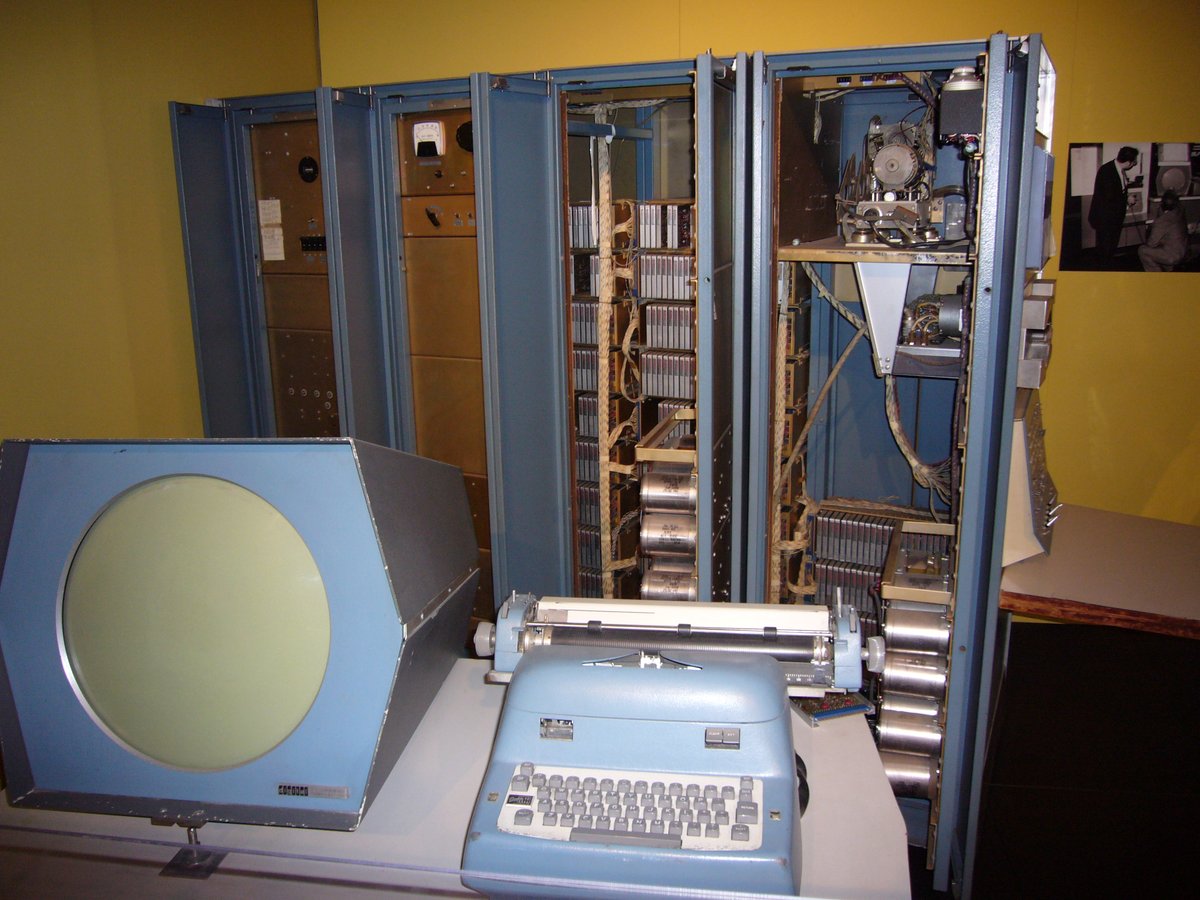
Figure 2.1 — DEC PDP-1, the canonical proto-hacker computer. File:PDP-1.jpg by Matthew Hutchinson. License: CC BY 2.0 (https://creativecommons.org/licenses/by/2.0). Via Wikimedia Commons (https://commons.wikimedia.org/wiki/File%3APDP-1.jpg).

A word on Levy as a source. Steven Levy’s Hackers: Heroes of the Computer Revolution (1984)3 is, by an order of magnitude, the most-cited single source for the period this volume covers. It was researched in the early 1980s by a journalist who interviewed many of the principals while they were still active, and it remains the indispensable narrative source for the MIT AI Lab era. Levy’s framing is, however, explicitly heroic: he is writing a celebration of these people and their values, and he says so. Subsequent historical scholarship — Markoff’s What the Dormouse Said4 in particular — has complicated some of Levy’s narrative beats, pointing out (for example) that the “purity” of the AI Lab hacker ethic was always intertwined with Department of Defense funding (ARPA money paid for the PDP-10s)11, and that the West-Coast counterculture and East-Coast institutional cultures were not as separate as Levy’s chapter structure implied. This volume cites Levy where he is the primary source and signals where it’s paraphrasing his interpretation rather than asserting a verifiable fact.
The summary picture you need to carry forward into the rest of this volume: by roughly 1965, there was a small, recognizable community of MIT-and-allied programmers who (a) had an explicit shared vocabulary including the word hack in its modern sense, (b) had access to interactive computers, (c) operated under a value system that they articulated in roughly the form Levy would later codify as the “hacker ethic” (§5), and (d) had no commercial pressure on the work — the machines and salaries were paid for by ARPA, the IBM contracts, the institutional research grants. The community defined itself by the work and by peer-judgment of the work. That is the cultural seedbed everything else in this volume springs from.
| Year | Event | Why it matters |
|---|---|---|
| 1946 | Tech Model Railroad Club founded at MIT | The vocabulary of hack originates here |
| ~1956 | TX-0 built at MIT Lincoln Laboratory | First transistor computer many hackers had hands-on time with |
| 1958 | TX-0 moved to MIT main campus (RLE) | TMRC people start using it after hours |
| ~1959 | TMRC Dictionary documents the hack vocabulary | Earliest written record of the modern sense |
| 1961 | DEC PDP-1 delivered to MIT | First commercial interactive computer at the AI Lab |
| 1961–62 | Spacewar! written by Russell, Graetz, Wiitanen et al. | First widely-distributed digital game; canonical proof-of-concept hack |
| 1959 | MIT Artificial Intelligence Project cofounded by Marvin Minsky and John McCarthy | The institutional home of the AI Lab hacker culture |
| 1965 | First Bell System SF (single-frequency) trunk circuits widely deployed | The signaling vulnerability §3 exploits enters wide use |
| 1969 | ARPANET first four-node network operational (UCLA-SRI-UCSB-Utah) | Precondition for the 1970s remote-hacking culture |
| 1971 | ”Captain Crunch” John Draper profiled in Esquire (October) | Phreaking becomes a public cultural phenomenon |
| 1971–72 | Wozniak and Jobs build blue boxes in Berkeley | Future Apple founders’ commercial start in proto-hacker tradecraft |
| 1975 (March) | Homebrew Computer Club’s first meeting in Menlo Park | Microcomputer revolution kicks off in the same value system |
| 1976 (Feb) | Bill Gates’ “Open Letter to Hobbyists” | First major public conflict: free-sharing culture vs. commercial software |
| 1979 | Compuserve, The Source come online | Pre-Internet commercial timesharing → 1980s BBS era → Vol 3 |
Table 2.1 — Timeline of the proto-hacker era’s major events. The chronology compresses considerably during the 1970s and explodes after 1975, which is why this series breaks into a separate volume at 1980.
3. The phone network as the first playground — phreaking
While the MIT crowd was building Spacewar! on the PDP-1, a parallel and largely unrelated proto-hacker culture was forming on the Bell System telephone network. It went by the name phreaking — a portmanteau of “phone” and “freak,” with a discomfort-with-spelling that is itself part of the cultural signature. Phreaking matters to this volume for three reasons. First, the technical content — the engineering theory of in-band signaling exploitation — is the prototype for every signaling-attack class still in use today, from cellular IMSI catching to the Wi-Fi PMKID capture, and the engineer-grade reader should understand the original mechanism. Second, the social culture of phreaking was the first national-scale technical-subculture community organized around exploiting a piece of infrastructure, and the dynamics — the zine-and-conference networks, the celebrity hackers, the law-enforcement counter-pressure — set the template for the 1980s computer-hacking culture covered in Vol 3. Third, the specific figures involved — Draper, Wozniak, Jobs, Engressia — are the human bridge between the East Coast computer-hacker world and the California garage-and-hippie culture that produced the personal computer.
3.1 Why the Bell System was hackable — in-band signaling
The technical vulnerability that phreaking exploited was not a bug. It was an architectural decision Bell Telephone Laboratories made in the 1950s, when they were upgrading the long-distance trunk network from operator-handled circuit-switching to direct-distance dialing12. The decision was to carry the supervisory signaling — the in-network control plane that tells the switches when a trunk is in use, when to release it, where to route the next call — on the same physical voice-frequency channel as the voice itself. This is in-band signaling, and as long as the only thing on a phone line was a Western Electric handset talking to a Class 5 end-office switch, it was perfectly fine: the customer’s handset couldn’t generate the signaling tones at frequencies above 2000 Hz, and even if it could, the end-office switch wouldn’t route those tones onto the trunk network anyway.
But once the call had been routed onto a long-distance trunk — once the customer’s voice was being carried as a 300-3400 Hz audio signal across the country, on the same wire that also carried the supervisory tones — the customer’s mouth and the supervisory channel were sharing a circuit. If the customer could generate the supervisory tones at the right amplitude into their handset, those tones would propagate down the trunk and the far-end switch would obey them. The architectural assumption was that customers wouldn’t be technically equipped or motivated to do this. That assumption held for about a decade.
            Customer's loop                  Long-distance trunk                 Far-end loop

  ┌─────────┐    voice + DTMF      ┌──────────┐   voice band (300-3400 Hz)   ┌──────────┐    ┌─────────┐
  │ Phone   │ ──────────────────► │ Class 5  │ ─────────────────────────►  │  Class 4 │ ──►│  Phone  │
  │ (caller)│ ◄────────────────── │ (CO end- │ ◄────────────────────────   │  (toll   │ ◄──│ (callee)│
  └─────────┘    voice            │ office)  │   voice + SUPERVISORY        │  switch) │    └─────────┘
                                   └──────────┘   in-band tones              └──────────┘
                                                       │
                                                       │  The supervisory tones
                                                       ▼  ride the same audio channel
                                              ┌─────────────────────┐
                                              │   2600 Hz: trunk    │
                                              │   idle / supervisor │
                                              │   MF tones:         │
                                              │   700/900/1100/     │
                                              │   1300/1500/1700 Hz │
                                              │   in pairs → digits │
                                              └─────────────────────┘

   ─── normal call: customer voice never reaches the trunk supervisory channel ───

   ─── phreaked call ───

  ┌─────────┐  voice + 2600 Hz   ┌──────────┐    "trunk is idle now"   ┌──────────┐
  │ Phone + │ ─────────────────► │ Class 5  │ ──────────────────────►  │  Class 4 │   trunk
  │ blue    │                    │ end-     │                          │  toll    │ ──RELEASES,
  │ box     │                    │ office   │                          │  switch  │   stays up
  │ caller  │                    │ (relays  │                          │  (hears  │   on caller side
  └─────────┘                    │ tone     │                          │  2600 Hz)│
                                 │ to trunk)│                          └──────────┘
                                 └──────────┘                                │
                                                                             │ then caller sends MF
                                                                             ▼ tones to dial freely
                                                                       ┌──────────┐
                                                                       │  Caller  │
                                                                       │  has now │
                                                                       │  seized  │
                                                                       │  the     │
                                                                       │  trunk - │
                                                                       │  no bill │
                                                                       └──────────┘
Figure 2.2 — The in-band signaling architecture of the 1960s Bell System trunk network, and the phreaking exploitation pattern. The supervisory tones that signal “trunk idle” (a sustained 2600 Hz) and the multifrequency (MF) tones used for inter-switch dialing share the same 300-3400 Hz audio channel as the voice. A customer with a tone-generating device — Cap’n Crunch whistle, blue box, or 1971-era homemade oscillator — could inject those tones into the trunk-side of the call, causing the far-end switch to release the trunk while the near-end switch held it idle, and then dial freely on the seized trunk at no charge.
The fundamental attack pattern was a three-step:
- Dial a free or in-WATS long-distance number. Toll-free 800 numbers and inward-WATS lines (the precursors to the modern 1-800 system) routed the call across the long-distance trunk network at no charge to the caller — the receiving party paid. Critically, the caller’s local switch did route the call onto a long-distance trunk. The caller was now connected to a long-distance trunk.
- Send a 2600 Hz tone down the line. A sustained 2600 Hz tone was the Bell System’s signal for “this trunk is idle.” Hearing it, the far-end switch released the trunk on its side — disconnected the called party — but the near-end (caller’s) switch, which routed control on a different basis, held the trunk up on the caller’s side. The trunk was now seized by the caller, in a state the near-end switch thought was an in-progress call, and the far-end switch had released back into the pool.
- Dial freely using MF tones. With the trunk seized, the caller’s MF (multi-frequency) tone generator could now signal the network to dial any number the long-distance trunk system could route to, billed to the originally-dialed free call. The caller could route a call to anywhere in the Bell System, including international, at no charge.
The supervisory tone — 2600 Hz — is the most famous number in phreaking and is the source of 2600: The Hacker Quarterly’s name (founded by Eric Corley in 1984; covered in Vol 3). The frequency was chosen by Bell Labs engineers in the late 1940s because (a) it was in the voice band so the existing analog trunks would carry it, (b) it was near the high end of the band where speech energy is sparse, so naturally-occurring speech rarely sustained it long enough to trip the supervisory logic, and (c) it was a round number convenient for the test-set generators of the era.
Numeric callout — the actual MF tone pairs. Once a trunk was seized via 2600 Hz, dialing was done with multifrequency (MF) signaling, which used pairs of tones drawn from a six-tone set: 700, 900, 1100, 1300, 1500, 1700 Hz. Each digit was a unique pair. (Digit 1 = 700+900; digit 2 = 700+1100; etc.) The control tones KP (key pulse — begins the digit sequence) and ST (‘Start,’ but functionally the digit-sequence terminator that triggers trunk routing) used the 1100+1700 and 1500+1700 pairs respectively. This is MF-R1 signaling, the North American flavor; the international ITU-T variant MF-R2 used a different tone set and a different alphabet. The “tone dial” you punched into a residential phone in the same era is a different signaling system — DTMF, Dual-Tone Multi-Frequency, also called Touch-Tone — using a different 8-tone pair set (697/770/852/941 Hz row × 1209/1336/1477/1633 Hz column). DTMF was for customer-to-end-office signaling, not trunk-to-trunk. Phreaks generating MF tones were imitating the inter-switch signaling, not the user signaling.
3.2 From blue boxes to red boxes to extended dialing
The blue box was the canonical phreaking tool but not the only one. The box color taxonomy that emerged in the late 1960s and early 1970s differentiated tools by what part of the network they exploited.
| Box | Generates | Function | Era |
|---|---|---|---|
| Blue box | 2600 Hz + MF tones | Seize a long-distance trunk via 2600 Hz, then dial free using MF | ~1964 onward, peaked 1968–1975 |
| Red box | Coin-deposit tones (1700+2200 Hz bursts) | Simulate the tones a payphone sent the central office on coin insertion — fool the CO into thinking coins had been deposited | Late 1970s through 1990s payphone-era |
| Black box | Passive impedance change on the called party’s line | Prevent the calling party from being billed by spoofing the answer supervision (call never registered as connected at the toll switch even though voice path was up) | 1960s–1970s |
| Beige box | Standard handset + alligator clips | Tap any unattended phone line by clipping onto its loop (lineman’s handset, essentially) | ~1980s onward (post-blue-box, post-red-box) |
| White box | Portable DTMF keypad | Customer-side touch-tone dialing for places (like very old rotary phones) that didn’t have it | 1970s |
| Green box | Coin-collect / coin-return tones (700+1100, 1100+1700) | Force a payphone to return or eat coins — payphone harassment, not toll fraud | 1970s |
Table 2.2 — The box color taxonomy of analog-era phreaking. Each box exploited a different signaling-architecture decision in the Bell System’s circuit-switched analog network. The classification was a community convention rather than an official Bell Labs taxonomy; the colors were the phreaking community’s shorthand.
Beyond the boxes, phreaking developed a substantial body of technique that was social-engineering as much as electronic: cold-calling Bell System operators or accounting offices with credible-sounding internal jargon to extract test numbers, internal extensions, and operator-only routing codes; mapping the network through systematic trial dialing of unassigned area-code-plus-prefix combinations to find loop-around test pairs (two unassigned numbers that connected to each other and could be used as free conference bridges between two phreaks); accumulating and trading published or leaked Bell Labs technical documents, most famously a Bell System Technical Journal issue (variously cited as November 1954 or November 196013) which laid out the signaling architecture in unguarded detail. The cultural pattern that this established — system mapping through curiosity-driven probing combined with social-engineering against the system’s human operators — is identical in structure to the modern reconnaissance phase of a red-team engagement. The tooling changed; the methodology did not.
3.3 What the modern reader should retain
Today callout — DO NOT TRY THIS. Every technique in this section is a federal felony in the United States as of 2026 — 18 U.S.C. § 1029 (access device fraud), § 1343 (wire fraud), and depending on the circumstances § 2510-et-seq. (wiretapping) — and broadly criminalized in every other jurisdiction. Moreover, none of the techniques work on the modern phone network: the analog SS7 in-band signaling system that 2600 Hz attacks targeted was completely retired in the United States by the early 1990s in favor of out-of-band Common Channel Signaling System #7 (also called SS7, confusingly) that runs on a completely separate logical channel from the voice path, and was further superseded by Diameter and various IMS / SIP protocols in modern cellular and VoIP networks. A blue box plugged into a modern handset will do absolutely nothing because there is no in-band 2600 Hz supervisory listener anywhere on the path. The historical methods are interesting as engineering and as cultural history; they have zero operational relevance today. (Modern SS7 itself has its own well-documented vulnerabilities — SS7 location-tracking, SMS interception, etc. — but those are an entirely different class of attack, treated in the modern cellular-tradecraft material of Vol 13 and adjacent.)
The technical operational value to the modern reader is the architectural lesson: in-band signaling — sharing a control channel with a data channel — is a recurring mistake, and recognizing it on sight is part of senior-engineer tradecraft. The same pattern shows up in Vol 14 (Wi-Fi) where 802.11 management frames are unauthenticated and on the same channel as data; in Vol 15 (RFID/NFC) — MIFARE Classic, a more recent instance of the same in-band-control failure pattern where MIFARE Classic mixed encrypted and unencrypted data on the same logical channel; in nearly every protocol-level vulnerability still being found in 2026 industrial protocols and IoT signaling. The boxes are a dead artifact; the lesson is operational.
4. Captain Crunch, the Esquire article, and Woz/Jobs’ blue-box hustle
The phreaking community had been growing quietly through the late 1960s — Joybubbles (Joe Engressia)14, a blind teenager in Tennessee who could whistle 2600 Hz purely with his own mouth, was a community hub from the early 1960s onward; Mark Bernay had built and distributed blue boxes; the “phone phreaks” had their own loose newsletters and conference-call networks. The community surfaced into mainstream culture in October 1971 with a single magazine article.
Ron Rosenbaum, “Secrets of the Little Blue Box,” Esquire, October 197115. The article ran in a national general-interest men’s magazine with a circulation in the hundreds of thousands, profiled a phreak going by the handle “Captain Crunch” and an ensemble cast of other phreaks (Joybubbles among them), described the technology of the blue box in detail (though not at a build-it-yourself level), and conveyed the cultural texture of the phreaking community to a public that had not previously known the community existed. The article was a landmark in two ways: it was the first mainstream-media treatment of a hacker community (modern sense), and it functioned as recruitment — many later phreaks and computer-hackers said they got into the field after reading Rosenbaum.
4.1 The figure — John Draper
The “Captain Crunch” of the Rosenbaum article was John Draper (born 1943), a former U.S. Air Force radio technician with an electronics-and-radio background who had been independently doing phone-network exploration since the late 1960s16. The origin story for his nickname — and it is partly apocryphal, with the details varying between Draper’s own tellings — is that a plastic toy whistle distributed as a promotional item inside boxes of Cap’n Crunch breakfast cereal in the late 1960s, when blown with one of its two holes covered, generated a tone of approximately 2600 Hz, the trunk-supervisory frequency. The whistle worked, in this telling, well enough to seize Bell System trunks when blown into a handset. The story is plausible — Cap’n Crunch did include cereal-box whistles in that era, and a single-tone whistle of the right physical dimensions can produce a tone near 2600 Hz — but the historiography of whether Draper was the first phreak to discover this, or whether the cereal whistle was the original tool of phreaking (it wasn’t — Joybubbles and others were using oscillators and whistled tones earlier), has hardened around Draper because of the Rosenbaum article rather than the technical record17. The defensible statement is that Draper popularized the cereal-whistle method and the Esquire article cemented the association.
Draper’s life trajectory after the Esquire article is well-documented and is the sort of story that this volume signals it will handle factually. He was arrested by the FBI in 1972 on toll-fraud charges, was convicted, served a short federal sentence; was arrested again in 1976 for further phreaking; pivoted in the late 1970s into legitimate work, writing EasyWriter, the first word-processor for the Apple II (later licensed to IBM for the IBM PC’s launch software)18; remained an active and visible figure in the hacker community through the 1980s, 1990s, and 2000s; and from approximately 2017 onward was the subject of multiple public accounts of inappropriate physical conduct around younger men at hacker conferences, which his publishers and former associates have largely treated as credible and led to his being disinvited from many conference appearances thereafter19. The volume’s stance is to treat Draper as a historically important figure whose technical contributions and cultural influence are real and documented, and whose later personal conduct is also documented and is not minimized. The romantic mid-1980s rendition of Draper-as-tragic-genius is no longer the responsible reading.
4.2 The Woz / Jobs blue-box business
The Esquire article had a second, more consequential reader. Steve Wozniak, then a 21-year-old engineering student at UC Berkeley, read it within weeks of publication, recognized that the article’s circuit description was workable, and over the next several days built a working blue box from his own design with Steve Jobs, then a 16-year-old high-school senior at Homestead High in Cupertino20. Wozniak’s own account in iWoz (2006) places the construction in late 1971 to early 1972; the details — the specific oscillator topology (a Wozniak-designed digital tone generator rather than the analog dual-LC oscillators most blue boxes of the era used — Wozniak’s version was more reliable), the field testing on Bay Area pay phones, the eventual decision to sell pre-built blue boxes around the Berkeley dorms at $80 to $150 each — are documented in Wozniak’s memoir at substantial length.
The Wozniak-Jobs blue-box business operated for approximately 18 months (~1971 into 1972) before they wound it down due to escalating risk and a near-arrest incident at a Sunnyvale gas station that Wozniak’s account narrates in some detail21. Approximately two hundred units were sold by Wozniak’s count. The historical significance is not the toll fraud — it was a relatively modest business in absolute terms — but the causal chain: Wozniak’s first commercial product, designed and built with Jobs as his business partner, was a phreaking device. The technical partnership and the entrepreneurial dynamic that would later produce the Apple I (1976), Apple II (1977), and the founding of Apple Computer were first established in the Berkeley-and-Cupertino blue-box hustle of 1971–72.
Connection forward. Apple, Hewlett-Packard’s calculator division, and Atari (where Jobs worked from 1974) were all running on talent that had come through the same Bay Area Homebrew-and-phreaking subculture. The microcomputer revolution covered in §6 grew out of exactly the same social network that the phreaks of §3-4 were embedded in. This is not a coincidence; it is the same culture producing different artifacts as the technology base shifted.
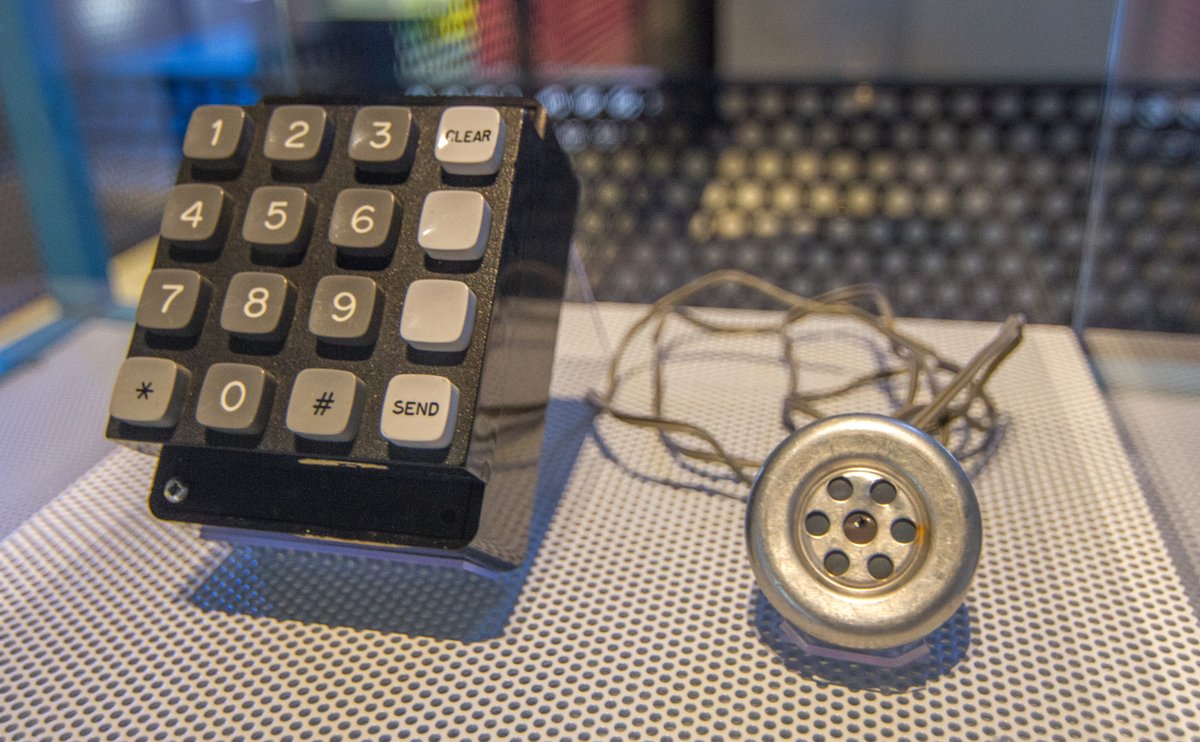
Figure 2.3 — A blue box on display at the Powerhouse Museum in Sydney. File:Blue Box at the Powerhouse Museum.jpg by Maksym Kozlenko. License: CC BY-SA 4.0 (https://creativecommons.org/licenses/by-sa/4.0). Via Wikimedia Commons (https://commons.wikimedia.org/wiki/File%3ABlue%20Box%20at%20the%20Powerhouse%20Museum.jpg).

4.3 The key figures of the era — a roster
| Figure | Role | Era | Why they matter |
|---|---|---|---|
| Joybubbles (Joe Engressia) | Blind phreak, “the whistler,” community hub | ~1957–2007 | The earliest documented continuous phreak; whistled 2600 Hz natively |
| John Draper (“Cap’n Crunch”) | Phreaking popularizer, Esquire article subject | Active 1968–1990s | The face of phreaking after Rosenbaum 1971; later EasyWriter author |
| Ron Rosenbaum | Journalist | Esquire article October 1971 | Wrote the article that surfaced phreaking to the public |
| Steve Wozniak | Blue-box builder, future Apple cofounder | 1971–72 (boxes); 1976+ (Apple) | First commercial design was a phreaking device; the bridge from phreak culture into the microcomputer revolution |
| Steve Jobs | Wozniak’s business partner | 1971–72 (boxes); 1976+ (Apple) | Sold the blue boxes; the business-side half of the team that became Apple |
| Steve Russell | Spacewar! lead programmer | 1961–62 (Spacewar!) | First widely-distributed digital game; canonical PDP-1 hack |
| Marvin Minsky | MIT AI Lab founder, “father of AI” | 1959+ | Institutional patron who tolerated and arguably encouraged the hacker culture at the AI Lab |
| Richard Stallman (“RMS”) | MIT AI Lab hacker, later founder of GNU | 1971+ (joined AI Lab) | The continuation of the AI Lab ethic into the free-software movement of the 1980s — see Vol 3 |
| Fred Moore, Gordon French | Homebrew Computer Club cofounders | 1975 onward | Founded the club that catalyzed the microcomputer revolution (§6) |
| Lee Felsenstein | Homebrew regular, Osborne 1 designer | 1975 onward | ”MC” of the Homebrew meetings; central organizer of the kit-builder community |
| Bill Gates | Microsoft cofounder | 1975 onward | ”Open Letter to Hobbyists” (1976) — first major public conflict between commercial and free-sharing culture |
Table 2.3 — Selected key figures of the proto-hacker era. The list is deliberately not exhaustive; it covers the figures whose names recur most often in subsequent volumes’ cross-references.
5. The minicomputer & timesharing era — the original “hacker ethic”
By the late 1960s, the institutional hacker culture that had crystallized around the TX-0 and the PDP-1 at MIT had spread to a handful of other places that shared three properties: ARPA funding (the U.S. Defense Advanced Research Projects Agency, in particular its Information Processing Techniques Office under J.C.R. Licklider and his successors, was paying for most of this), time-sharing minicomputers that supported multiple interactive users (the PDP-6, then the iconic PDP-10), and a research-lab culture that tolerated extensive informal use of the machines outside the funded-project workload. The three principal sites were the MIT Artificial Intelligence Laboratory, where the original PDP-1 culture matured into a PDP-6-then-PDP-10-based shared-machine working style; the Stanford AI Lab (SAIL) under John McCarthy, with its own PDP-10 and a distinct but kindred culture; and Carnegie Mellon University’s computer science group, running its own ARPA-funded research programs separate from MIT’s Multics effort. Multics itself (an MIT-Bell-Labs-GE collaboration, 1964–) anchored the timesharing design space that all three hubs (MIT, Stanford, CMU) operated in.
The single most-cited articulation of the values that emerged from these communities is Steven Levy’s six-tenet “hacker ethic”, formulated in the first two chapters of Hackers: Heroes of the Computer Revolution (1984)3. Levy distilled the ethic from extensive interviews with the MIT AI Lab hackers, in particular Bill Gosper, Richard Greenblatt, and Richard Stallman. It is important to be clear that Levy’s six tenets are Levy’s synthesis — the AI Lab people themselves did not, as a group, agree on a written six-point creed; Levy organized what was actually a more diffuse set of working norms into a clean list because clean lists make for better magazine excerpts and book chapters. With that caveat, the six tenets are widely-cited and are useful as a coherent map of what the culture actually held. The list with engineer-grade annotation follows.
| # | Tenet (Levy 1984) | What it meant in context | How it aged | Modern echo |
|---|---|---|---|---|
| 1 | ”Access to computers — and anything which might teach you something about the way the world works — should be unlimited and total.” | In 1965 most people had zero access to a computer ever. The tenet was an explicit protest against the IBM-mainframe-with-priesthood model. The “anything which might teach you” extension generalized to schematics, source code, technical manuals, the contents of locked offices when a system needed maintenance. | Aged poorly with respect to privacy and physical security; aged extremely well with respect to documentation. The expectation that a competent engineer can read the source for their own tools is now baseline. | Open source as infrastructure. Right-to-repair movement. The expectation that documentation is online, free, and complete. |
| 2 | ”Always yield to the Hands-On Imperative.” | If you can learn by physically taking it apart, you should. Boxes are meant to be opened. Locked doors are an injury, not a barrier. The lab door routinely got jimmied at 2 am to reach a misbehaving machine; this was considered normal. | The hands-on impulse aged well; the indifference-to-access-control aged catastrophically. Modern security-research culture has rebuilt the hands-on imperative inside a with-authorization framing (your own hardware, signed scope, sanctioned lab). | The maker movement. CTFs and home labs (Vol 9 — green hat on-ramp). The expectation that a security researcher should own and disassemble the hardware they study. |
| 3 | ”All information should be free.” | A specific cultural assertion against IBM’s proprietary-source policy and against the secrecy of corporate R&D. In the AI Lab’s actual practice, the source code of every system program was readable by anyone with a login; the disk had no per-user privacy enforced socially or technically. | The most-disputed and most-evolved tenet. The Stallman-led free-software movement carries it forward in a specific legal-license sense; the “information wants to be free” misquotation (§7) carries it forward in a broader and looser sense. The mainstream tech industry never adopted it. | GNU / Linux / open source as the dominant software-infrastructure model. Wikipedia, the open-knowledge movement, arXiv. But also the framing the criminal grey/black-hat culture uses to justify leaks and disclosures (Vol 8 — grey hat). |
| 4 | ”Mistrust Authority — Promote Decentralization.” | A specific reaction against MIT’s administration, the IBM mainframe priesthood, and ARPA’s bureaucracy (even though ARPA was paying for the work). Decentralization meant: many small machines accessible to their users, not one big machine accessible only via gatekeepers. | Aged well as a design heuristic for distributed systems. Aged into a specific cultural posture (the “infosec libertarianism” of much of the modern security community). | The internet’s foundational architecture. Distributed-systems engineering as a discipline. Peer-to-peer movements, decentralized finance, the modern security community’s general skepticism of vendor-and-regulator-driven solutions. |
| 5 | ”Hackers should be judged by their hacking, not bogus criteria such as degrees, age, race, or position.” | The MIT AI Lab had high-school students working alongside MIT faculty if the high-school student’s code was better. Credentialism was actively scorned. | Aged extremely well as an industry value; aged less well in practice because the actual hiring infrastructure is in fact heavily credentialed. The CTF and bug-bounty pathways (Vols 9, 18) are the modern non-credentialed paths in. | ”Show me your GitHub.” The bug-bounty platforms’ merit-based payout model. The CTF/HackTheBox/TryHackMe on-ramp into the field. Conference talks accepted on submission merit (DEF CON’s CFP is famously credential-blind). |
| 6 | ”You can create art and beauty on a computer.” | Easy to underestimate as a tenet now; in 1965 the proposition was contested. Spacewar! was an explicit demonstration. The Lisp Machine’s TECO-based editor, the elaborate AI Lab printer-display hacks, the music compositions Gosper would write — all of this was an active assertion that computing was an aesthetic discipline. | Aged so well it became invisible. The proposition is no longer worth arguing. | All of creative computing — demoscene, generative art, the entire game-development industry, computer music. The modern security-research aesthetic itself — elegant exploits versus brutal exploits is a real and used distinction in the community. |
| 7 (often given as separate) | “Computers can change your life for the better.” | In 1965 most people who interacted with computers did so via a bank statement or an IBM card. The AI Lab hackers genuinely believed — and acted as if — the computer was a tool of personal liberation. The Whole Earth Catalog’s adoption of the personal computer in the mid-1970s (Stewart Brand and adjacent) was the public-facing version of the same belief. | The cyber-utopian wave of the 1990s exhausted this tenet by association; the post-2010 backlash against Silicon-Valley culture has further damaged it. But the underlying claim — that getting a competent engineer access to a computer changes their cognitive capabilities permanently — is empirically defensible and largely unchanged. | The maker community. Personal-tooling culture. The “engineering as a tool of personal agency” framing that runs through this entire deep-dive series. |
Table 2.4 — Levy’s six (or seven) tenets of the hacker ethic, with engineer-grade annotation. The ethic was a specific situated value system rather than timeless wisdom, but several of its tenets have aged into infrastructure-level assumptions of the modern computing industry.
What the table does not capture is the affective texture of the AI Lab era — the all-nighters, the weird food-and-sleep patterns, the in-group humor, the deep commitment to the work as a kind of vocation. Levy’s Hackers documents this at length and is the source to consult. The relevant point for this volume is that the affective culture and the values were the same thing: people self-selected into the AI Lab because they already held the values, and the institutional setting both reinforced and transmitted the values to new arrivals. By the early 1970s the AI Lab — and SAIL, and CMU — were recognizable transmission vectors for a specific culture that produced a specific style of work.
Note callout — what the AI Lab era was NOT. The hacker ethic was not a manifesto for security research, vulnerability disclosure, or anything resembling modern penetration testing. The AI Lab people were systems builders — operating systems, AI languages, time-sharing infrastructure, robotics control. They wrote ITS (the Incompatible Timesharing System), Maclisp, MacHack chess, the original Emacs, the Lisp Machine. The closest thing the AI Lab had to “security research” was Richard Stallman’s principled refusal to use the AI Lab’s password system on the grounds that requiring passwords was a moral failure. The criminalization-era split (Vol 3) had not yet happened. The legal climate that turned “unauthorized access” into a federal crime had not yet been created. These people were engineers, not security professionals; the security profession would emerge in part by separating itself from this culture in the 1980s and 1990s.
6. The Homebrew Computer Club & the personal-computer pivot
The MIT/Stanford/CMU AI Lab culture was institutional. It depended on ARPA money, university buildings, and the kind of intellectual gravity that pulled talented people across the country to be hired or to drop in. The next phase of proto-hacker culture happened off-campus, in the San Francisco Bay Area, around a very different organizing principle: the microcomputer kit. The MITS Altair 8800, designed by Ed Roberts and announced in Popular Electronics’ January 1975 cover article22, was the catalytic artifact. For about $400 plus shipping ($397 for the kit, $498 for the assembled version)23, a hobbyist could now own — and physically assemble — a real computer, with a real Intel 8080 microprocessor, in their house. The implications took the hobbyist community about six weeks to absorb.
On Wednesday, March 5, 1975, in Gordon French’s garage in Menlo Park, California, the first meeting of what would become the Homebrew Computer Club convened24. The meeting was organized by Fred Moore and Gordon French in response to invitations Moore had distributed at the Peninsula’s various electronics-hobbyist gatherings (including the Whole Earth Truck Store, an outgrowth of Stewart Brand’s Whole Earth Catalog enterprise). Roughly 30 people attended the first meeting. Within a year, attendance had grown to several hundred per meeting and the venue had moved to a Stanford Linear Accelerator Center auditorium that the SLAC engineers among the membership had managed to wangle access to. The meetings ran roughly twice a month for about a decade, peaking in 1976–78 and tapering through the early 1980s as the people who had been kit-builders became kit-vendors and then companies with payrolls.
6.1 The mechanics of a Homebrew meeting
A typical Homebrew meeting in 1976 followed a format the club had developed organically:
- Mapping period (~30 minutes). Anyone in the room could announce themselves and a current project or a thing they were stuck on. The MC — most often Lee Felsenstein, an electrical engineer and counterculture activist who would later design the Osborne 125 — would call on people and triage the announcements.
- Random Access period (~60-90 minutes). People circulated, talked, traded chips and boards and circuit-board layouts and source code, made plans to meet at each other’s houses to work on specific problems.
- Featured discussion or demonstration (~30 minutes). Sometimes a planned talk; often a kit-builder showing the latest thing they had working. Steve Wozniak demonstrated an early prototype of what became the Apple I at a Homebrew meeting in 1976; he and Jobs would later say the club’s response was a substantial part of what convinced them the machine had a market.
The cultural posture was explicitly continuous with the AI Lab ethic — anyone who showed up could speak and contribute, schematics and code were freely shared, the meetings were free, and credit-for-good-work was the social currency. Felsenstein had directly imported much of the framing from the AI Lab era through his Bay Area counterculture-and-engineering connections (including the People’s Computer Company, an explicitly counterculture computer-access cooperative founded by Bob Albrecht in 1972)26. The difference from the AI Lab era was the commercial overlay: many Homebrew members were also founding or working at companies that sold the boards and software they were demonstrating. The tension this produced is what makes Homebrew a pivotal moment in this history.
6.2 The Gates “Open Letter” — first commercialization conflict
The cleanest moment of conflict between the AI-Lab-derived sharing ethic and the emerging commercial reality was the “Open Letter to Hobbyists” published by Bill Gates in the Homebrew Computer Club Newsletter in February 197627. Gates, then 20 years old and a founding partner of the tiny Albuquerque-based Micro-Soft, had written an Altair BASIC interpreter (with Paul Allen and Monte Davidoff) which the company was selling for $150 a copy. Pirate paper tapes of Altair BASIC were circulating freely in Homebrew membership — Gates’ own account had it that the bootleg copies outnumbered the licensed ones by something like ten to one. His letter, written in indignant prose, accused the hobbyists of theft, and asserted that “most of you steal your software” — and that as a result, “who can afford to do professional work for nothing?”
The letter was a small bomb. The hobbyist community read it as a betrayal of the ethic; Gates and his company read the hobbyists’ response as confirmation that they were dealing with thieves who had no concept of intellectual property. Neither side was wrong on its own framing. The Gates Open Letter is conventionally read as the first public document of the wedge that would, over the following decade, split the AI-Lab-descended free-sharing culture from the emerging commercial-software industry. The conflict has never fully been resolved. The dominant modern model is a hybrid — much core infrastructure is open-source (Linux, BSD, the entire GNU toolchain, the web’s protocol stacks), and much application software is proprietary — but the underlying philosophical question (when should code be shareable, when should it be paid for?) is still actively contested forty-five years later. Stallman’s GNU Manifesto (Vol 3, 1985)28 and the entire free-software-versus-open-source-versus-proprietary debate are the descendants of the Gates Open Letter argument.
6.3 What Homebrew produced
The roster of companies founded by Homebrew members or whose key technical staff came through the club is, in retrospect, absurd. A partial list:
| Company | Founder(s) with Homebrew connection | Founded |
|---|---|---|
| Apple Computer | Steve Wozniak, Steve Jobs (Wozniak demonstrated the Apple I at Homebrew) | 1976 |
| Osborne Computer Corporation | Lee Felsenstein (designer, Osborne 1) | 1980 |
| Cromemco | Harry Garland, Roger Melen (founding Homebrew regulars) | 1976 |
| North Star Computers | Mark Greenberg, Chuck Grant, others | 1976 |
| Processor Technology (SOL-20) | Bob Marsh, Lee Felsenstein, Gordon French | 1975–76 |
| IMSAI (IMSAI 8080) | Bill Millard (employees Joe Killian, Bob Marsh recruited via Homebrew) | 1975 |
| Atari | Nolan Bushnell (not founded at Homebrew, but Atari engineers were Homebrew regulars; Steve Jobs worked there 1974) | 1972 |
Table 2.5 — Selected companies whose origins include Homebrew Computer Club members. Apple is the survivor; most of the others were absorbed, faded, or pivoted by the late 1980s, but collectively the cohort produced the first decade of the personal-computer industry.
The connection back to TMRC and the AI Lab is direct and traceable. TMRC → MIT AI Lab → AI-Lab-derived values via Felsenstein and adjacent figures → Homebrew → personal-computer industry. The transmission was not always literal — most Homebrew members had never set foot in the MIT AI Lab — but the value system traveled via books (the AI Lab people had published and the publications had been read), via the People’s Computer Company and the Whole Earth Catalog as Bay Area mediators, and via specific intermediaries like Felsenstein, who had been in the broader hacker culture from the 1960s.
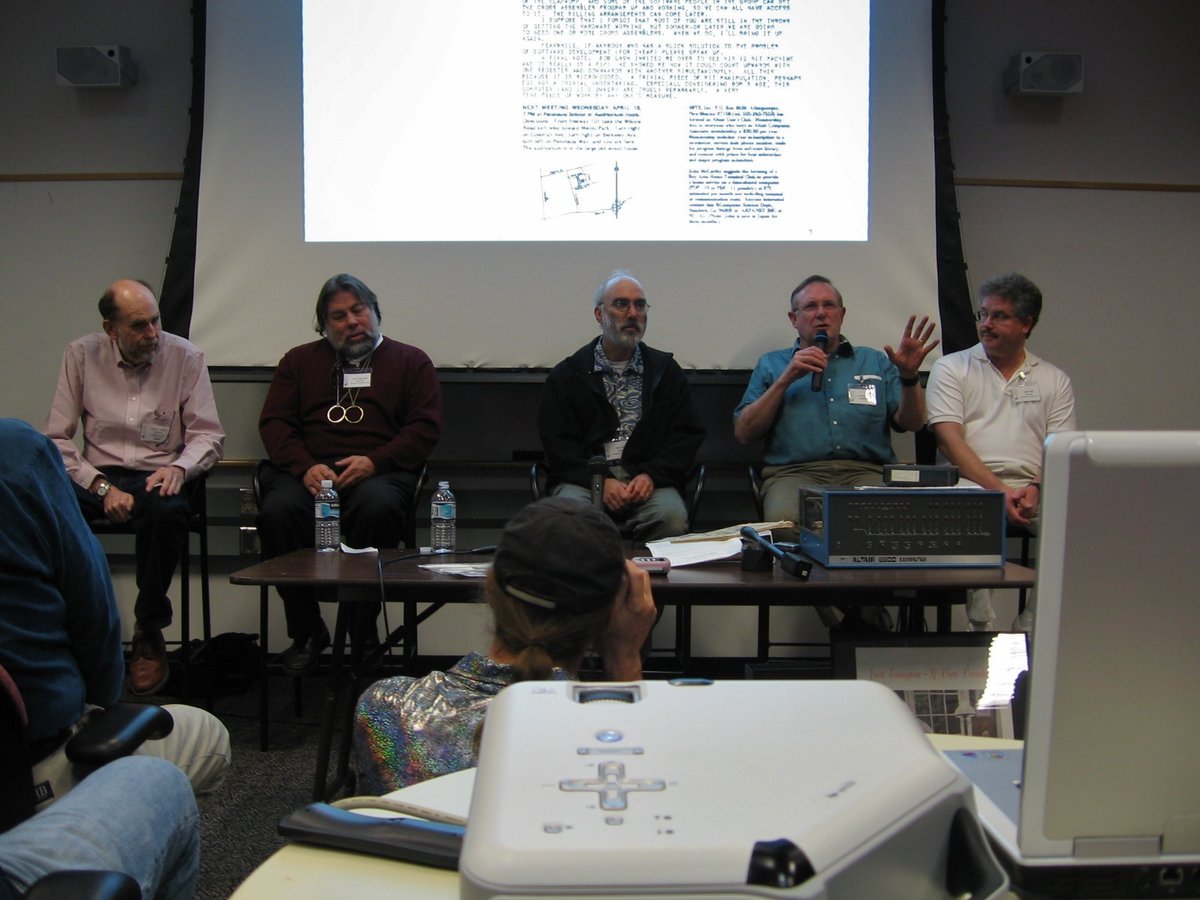
Figure 2.4 — Homebrew Computer Club 30th-anniversary retrospective, 2005. File:Homebrew Computer Club 30th Anniversary Retrospective (2283385138).jpg by Marcin Wichary from San Francisco, Calif. License: CC BY 2.0 (https://creativecommons.org/licenses/by/2.0). Via Wikimedia Commons (https://commons.wikimedia.org/wiki/File%3AHomebrew%20Computer%20Club%2030th%20Anniversary%20Retrospective%20(2283385138).jpg).
.jpg)
6.4 The lineage diagram
                  ┌──────────────────────────┐
                  │   MIT TMRC               │
                  │   (1946-)                │
                  │   "hack" vocabulary      │
                  └────────────┬─────────────┘
                               │
                  ┌────────────▼─────────────┐
                  │   TX-0 (1958-)           │
                  │   first hacker computer  │
                  └────────────┬─────────────┘
                               │
                  ┌────────────▼─────────────┐
                  │   MIT AI Lab + PDP-1     │
                  │   (1961-)                │
                  │   Spacewar! (1962)       │
                  │   - Minsky, Russell,     │
                  │     Greenblatt, Gosper,  │
                  │     Stallman             │
                  └─────┬───────────────┬────┘
                        │               │
                        │               │  (West Coast diffusion via
                        │               │   Felsenstein, PCC, the
                        │               │   Whole Earth Catalog)
                        │               │
                  ┌─────▼─────┐    ┌────▼────────────┐
                  │ Stanford  │    │ Berkeley /      │
                  │ SAIL      │    │ Bay Area        │
                  │ (PDP-10)  │    │ Phreaks         │
                  │           │    │ - Joybubbles    │
                  │ AI Lab    │    │ - Draper        │
                  │ tradition │    │ - Wozniak/Jobs  │
                  │ via       │    │   blue boxes    │
                  │ McCarthy  │    │   1971-72       │
                  └───────────┘    └────┬────────────┘
                                        │
                              ┌─────────▼────────────┐
                              │ Altair 8800 Jan 1975 │
                              │ (catalyst, not       │
                              │  Homebrew member)    │
                              └─────────┬────────────┘
                                        │
                              ┌─────────▼────────────┐
                              │ Homebrew Computer    │
                              │ Club, March 1975     │
                              │ - Moore, French,     │
                              │   Felsenstein        │
                              │ - Wozniak demos      │
                              │   Apple I 1976       │
                              │ - Gates Open Letter  │
                              │   Feb 1976           │
                              └─────────┬────────────┘
                                        │
                              ┌─────────▼────────────────────┐
                              │ Personal-computer industry   │
                              │ Apple, Osborne, Cromemco,    │
                              │ NorthStar, IMSAI, ...        │
                              │ Microsoft (the Other side)   │
                              │                              │
                              │ (lineage continues into       │
                              │  Vol 3: BBS culture, the     │
                              │  1980s-1990s)                │
                              └──────────────────────────────┘

   Key: cultural transmission was not always direct staffing -
   it traveled via published accounts, intermediary organizations
   (People's Computer Company, Whole Earth), specific bridge
   figures (Felsenstein), and the small social world of
   1970s computer enthusiasm.
Figure 2.5 — Cultural-transmission lineage from TMRC through the Homebrew Computer Club into the personal-computer industry. The diagram is simplified; in reality the diffusion was multi-channel and ran in parallel through several intermediary organizations.
7. The values: openness, decentralization, “information wants to be free”
The proto-hacker era left behind a small number of phrases that became cultural shorthand for the values of the period. The most famous of these is “information wants to be free,” and it is worth getting right, because the popular version is a misquotation that distorts the original speaker’s actual position into something simpler and less defensible.
The phrase originates with Stewart Brand — founder of the Whole Earth Catalog, organizer of the first Hackers Conference in 1984 (which was itself an outgrowth of the Levy book), and later a founder of the WELL (Whole Earth ‘Lectronic Link, an early online community)29. Brand spoke the phrase at the 1984 Hackers Conference, in a remark addressed to journalist Stewart Alsop II30. He restated and finalized it in print in his 1987 book The Media Lab: Inventing the Future at MIT, p. 202. The complete passage as printed is:
“Information wants to be free. Information also wants to be expensive. Information wants to be free because it has become so cheap to distribute, copy, and recombine — too cheap to meter. It wants to be expensive because it can be immeasurably valuable to the recipient. That tension will not go away. It leads to endless wrenching debate about price, copyright, ‘intellectual property,’ the moral rightness of casual distribution, because each round of new devices makes the tension worse, not better.”31
Brand’s actual claim is dialectical: information has two contradictory tendencies and both are real, and the unresolved tension between them is the central problem of the information economy. The popular version — “information wants to be free” alone, used as a rallying-cry maxim — strips out the dialectic and presents the tension as if it had already been resolved in favor of one side. Brand has been unhappy with this for forty years; in a 2010 interview he noted that “Information wants to be free ‘is’ the most misquoted statement I’ve ever made”32.
This is worth flagging engineer-grade carefully because the truncated version has been used to justify a great deal of behavior — from the philosophical (Stallman’s free-software argument, Vol 3) to the legally contested (the 2000s file-sharing culture) to the unambiguously criminal (the modern dark-web data-broker market). The dialectical version that Brand actually advanced is much harder to weaponize: it implies that information’s free side and information’s expensive side are both real, that any working system has to manage the tension rather than resolve it, and that the people on each side of the line have at least defensible positions. That’s a useful frame for thinking about modern questions like responsible disclosure (Vol 8 — grey hat — disclosed without authorization but pre-coordinated; that’s the dialectic in action), bug-bounty pricing (Vol 18 — careers), or for that matter the open-source-versus-proprietary question that started with the Gates Open Letter.
The other phrases the proto-hacker era left behind are smaller but worth noting:
- “The hacker ethic” — Levy’s 1984 framing (§5). Not a phrase the AI Lab people themselves used as a unit; Levy retconned it as a shorthand for what the culture actually held.
- “Computers for the people” — the People’s Computer Company’s tagline, mid-1970s. Strong Bay Area counterculture flavor; the seed of the populist-computing rhetoric that would saturate the 1980s.
- “The right tool” / “the right kind of hack” — AI Lab in-group judgments about technical work. The aesthetic dimension (Levy tenet 6) made operational.
- “Two steve hippies in a garage” — the founding-myth template for Apple, applied (often inaccurately) to Microsoft, HP, and every Silicon Valley startup story since. The garage as origin is the actual physical setting Wozniak and Jobs (and many of their Homebrew peers) worked in; the myth-template generalized.
Engineer-grade takeaway: the values of the proto-hacker era were real and operational, but they were never as clean or as universally held as the bumper-sticker versions suggest. Brand was making a much more sophisticated argument than the slogan implies; the AI Lab “ethic” was a heterogeneous and often-contested set of working norms rather than a creed; the Homebrew commercialization conflict was not resolved in either direction. Reading the period responsibly means holding the complexity, not collapsing it into a one-sentence summary.
8. What carried forward / what didn’t — values → hats mapping
The point of this volume is the inheritance: which proto-hacker-era values are still operative in the modern practice of hacking, and which ones got left behind. The table below maps each tenet to where it lives today and where the tension is. The hat-color terminology in the “Where it lives today” column refers forward to Vols 6 through 12 of this series, where each hat is treated in full.
| 1970s value | Where it lives today | Tension |
|---|---|---|
| Access to computers should be unlimited and total (Levy 1) | Mostly in white hat (right-to-repair, the working assumption that a competent engineer can document and disassemble their own tools) and grey hat (unauthorized disclosure framed as “access activism”) | Privacy, intellectual property, and physical security all push the other direction. The 1970s assumption that the lab door should jimmy open at 2 am does not survive any modern threat model. The compromise is authorized hands-on: own the hardware, get the scope, work in a sanctioned environment. |
| The Hands-On Imperative (Levy 2) | Green hat (the home-lab / CTF on-ramp), white hat (the disassembly-as-method tradition of vulnerability research), red hat (physical-access engagements) | Doing hands-on work on anything you don’t own and aren’t authorized to test is a federal felony in the United States and broadly criminalized elsewhere. The 1970s hands-on impulse lives on inside the authorization frame; outside it, it’s the lead-in to a CFAA charge. |
| All information should be free (Levy 3) | The Stallman free-software lineage, the open-source movement (still vibrantly operational), arXiv / preprint culture, the open-knowledge community. Also: black hat (criminal disclosure markets, ransomware-as-a-business’ double-extortion model) — note this is the appropriation of the slogan, not its original sense. | The strongest of the original tenets to survive as infrastructure; also the most weaponized rhetoric. Brand’s full dialectical version (§7) is closer to truth than either pole. |
| Mistrust Authority — Promote Decentralization (Levy 4) | A general posture across most of the hat spectrum, but particularly visible in grey hat (independent-researcher discourse), parts of black hat (the cyberlibertarian framing of some criminal-hacking activity), and in the architecture of distributed systems (which is now infrastructure) | The internet’s foundational architecture is decentralized; the actually-used internet of 2026 is highly centralized (three cloud providers, two phone OSes, one CDN running half the web). The tenet survives as cultural posture but the world it would shape has consolidated. |
| Hackers judged by hacking, not credentials (Levy 5) | Green hat and white hat: the CTF / bug-bounty / “show me your GitHub” hiring model. Red hat team hiring also leans heavily on demonstrated skill versus paper credentials. | The actual industry is now heavily credentialed (OSCP, CISSP, GIAC). The “show me your work” pathway exists but is rarely a complete substitute for credentials at the senior level. The two coexist uneasily. |
| Art and beauty on a computer (Levy 6) | Every aesthetic-conscious technical discipline. Within hacking specifically: the elegant-versus-brutal exploit distinction, the demoscene, conference-presentation craft (DEF CON, Black Hat) | No serious tension. The tenet aged into invisibility. |
| Computers can change your life for the better (Levy 7) | Maker movement, green hat (the on-ramp narrative). The framing this entire deep-dive series uses (computing-as-personal-agency). | Substantial post-2010 cultural backlash against the unqualified version of the claim. The qualified version (engineering literacy as personal capability) is largely uncontested. |
| ”Information wants to be free” (Brand, mis-quoted) | Across white hat, grey hat, black hat — used very differently in each. The dialectical original (information wants to be both free and expensive, the tension is real) is the version that’s responsibly cited; the truncated maxim is the version that’s frequently cited. | The single largest source of bad rhetoric in modern hacker discourse. Brand’s actual position is engineer-grade; the slogan is not. |
Table 2.6 — Values-to-hats mapping. The 1970s proto-hacker era contributed real material to modern hacking practice, but the contribution was uneven: some tenets are now infrastructure, some are contested working norms, and at least one has been substantially appropriated for purposes its originators would not endorse. The hat volumes (Vols 6-12) treat each row in full, with the hats’ specific framings.
The thing this table doesn’t show — but which the rest of the series will return to repeatedly — is the legal climate inversion between the proto-hacker era and the modern era. In 1970, “unauthorized access to a computer” was not a federal crime in the United States; the CFAA was passed in 1986 and substantially expanded through the 1990s and 2000s (Vol 3, Vol 19). The AI Lab people working in 1965 to 1975 could not have committed the federal crimes that the same set of activities would constitute in 2026 — the laws didn’t exist yet. This is part of why a great deal of behavior that was simply normal hacker behavior in the proto-hacker era is now, as a strict legal matter, criminal. The hat-spectrum framework is in part a response to this legal reality: it provides a vocabulary for distinguishing the activities that should remain legal (white hat, authorized engagements) from those that are now criminalized (black hat, unauthorized intrusions) while acknowledging the awkward middle territory (grey hat) where the activity is technically unauthorized but motivated by something other than personal gain or destruction. None of that vocabulary existed in 1975. The legal climate created the need for the vocabulary.
Look here for more. Vol 3 picks up exactly where this one leaves off: the 1980s and 1990s, when the AI Lab era’s value system met the personal computer’s commercial reality, the CFAA, the FBI’s prosecution apparatus, and the emergence of the bulletin-board-system underground. The 414s, the Morris worm, the prosecution of Craig Neidorf over the E911 document, the Mitnick years, the founding of 2600, Phrack, the Chaos Computer Club, the EFF, DEF CON — all of that is the next chapter, and all of it sits on the foundation this volume laid.
9. Cheatsheet updates and Resources
Cheatsheet entries for Vol 20 — one-liners worth retaining from this volume.
- Hack in the modern sense originates in the MIT Tech Model Railroad Club, late 1950s.
- The TX-0 (1958) and PDP-1 (1961) at the MIT AI Lab were the first “hacker computers”; Spacewar! (Russell et al., 1961–62) is the canonical PDP-1 hack.
- The Bell System’s vulnerability to phreaking was in-band signaling: trunk-supervisory tones rode on the same audio channel as voice. The architectural lesson is recurring; it shows up again in 802.11 management frames, MIFARE Classic, and most pre-2010 protocol-level bugs.
- 2600 Hz = trunk-supervisory idle tone. Holding it on a seized trunk fooled the far-end switch into releasing while the near-end held the trunk open. Origin of 2600: The Hacker Quarterly’s name.
- MF-R1 tone pairs (for inter-switch dialing once the trunk was seized): 700, 900, 1100, 1300, 1500, 1700 Hz. DTMF (the customer-side touch-tone system) is a different signaling system, not the phreaking target.
- Box color taxonomy: blue (seize trunk), red (fake coin deposit), black (avoid billing), beige (line tap), green (force coin return), white (portable DTMF pad).
- Ron Rosenbaum, “Secrets of the Little Blue Box,” Esquire, October 1971 — the article that popularized phreaking.
- Wozniak and Jobs built and sold blue boxes 1971–72 — their first commercial product, pre-Apple.
- Levy’s six tenets (or seven, depending on the count): unlimited access; hands-on imperative; information free; mistrust authority/promote decentralization; merit over credentials; art and beauty on computers; computers change life for the better.
- The Homebrew Computer Club first meeting: March 5, 1975, Menlo Park, in Gordon French’s garage. Founded by Fred Moore and Gordon French; MC was usually Lee Felsenstein.
- The Gates “Open Letter to Hobbyists,” Homebrew Newsletter, February 1976 — first major public conflict between free-sharing culture and commercial software.
- “Information wants to be free” is half a quote. Stewart Brand, 1984 Hackers Conference / Media Lab book 1987: information wants to be both free AND expensive; the tension between is the central problem.
- In 1975, none of this was illegal in the modern CFAA sense. The legal climate that distinguishes “white hat” from “black hat” was created in 1986 (CFAA) and after. The hat vocabulary is in part a response to that legal climate; in 1975 nobody used it. → Vol 3 picks up the criminalization wave.
- Captain Crunch / John Draper: technical figure popularized by Rosenbaum 1971; later EasyWriter author; from 2017 onward, credibly accused of misconduct at conferences. Treat factually, neither hagiographic nor dismissive.
Resources.
The footnotes below provide the citations for every factual claim in this volume. The primary sources to consult for the period are:
- Levy 19843 — the canonical popular history.
- Markoff 20054 — corrective and expansive on the West Coast counterculture connections.
- Wozniak 200620 — the first-person account of the blue-box era and Apple’s founding.
- Rosenbaum 197115 — the magazine article that surfaced phreaking to the public.
- Brand 198731 — the original printed version of “information wants to be free” with the dialectical context.
- Hafner & Lyon 19965 — for the ARPANET and the broader institutional context.
- The original PDP-1 documentation33 — for any technical detail of the machine itself.
The 2600 Hz tone, the Bell System Technical Journal, and the various blue-box schematics are all in the public domain or freely available via archives. The DEC PDP-1 itself is on display and operational at the Computer History Museum in Mountain View, California — Spacewar! is run on it occasionally for demos, and the museum’s restoration is the canonical reference for the actual machine. The MIT AI Lab itself was dissolved into MIT CSAIL in 2003; the Building 26 location of the TX-0 era is gone. The TMRC, however, still meets — same building, same model-railroad layout (extensively rebuilt), same kind of clever-hack people.
This is Volume 2 of the Hacker Tradecraft series. Next: Vol 3 covers the 1980s and 1990s — the bulletin-board era, the 414s, the Morris worm of 1988, the founding of the EFF (1990), the CFAA criminalization wave, the Mitnick years, the early hacker zines (2600, Phrack), and the inflection points (DEF CON 1, 1993; Black Hat 1, 1997) at which the modern hat-vocabulary started to take shape.
Footnotes
-
See Vol 3 — History II: golden age and criminalization for the 1980s-1990s arc, picking up exactly where this volume leaves off. ↩
-
See Vol 5 — The hat metaphor: origin and migration for the archeology of the hat vocabulary itself, which postdates the period this volume covers. ↩
-
Levy, Steven. Hackers: Heroes of the Computer Revolution. Anchor Press/Doubleday, 1984. 25th-anniversary edition O’Reilly Media, 2010, ISBN 978-1-449-38839-3. The canonical popular history of the period — the MIT TMRC, the AI Lab, Homebrew, and the early personal-computer industry — based on extensive interviews conducted in the early 1980s. Cited throughout this volume; readers consulting the original should note that Levy’s framing is explicitly heroic and that subsequent scholarship has complicated several of his narrative beats. ↩ ↩2 ↩3 ↩4
-
Markoff, John. What the Dormouse Said: How the Sixties Counterculture Shaped the Personal Computer Industry. Viking, 2005. ISBN 978-0-670-03382-3. The corrective and West-Coast-centered companion to Levy’s MIT-centered narrative; covers the SAIL crowd, the Augmentation Research Center under Douglas Engelbart at SRI, the People’s Computer Company, and the broader Bay Area counterculture-and-engineering scene out of which Homebrew emerged. ↩ ↩2 ↩3
-
Hafner, Katie, and Matthew Lyon. Where Wizards Stay Up Late: The Origins of the Internet. Simon & Schuster, 1996. ISBN 978-0-684-83267-8. The canonical reported history of the ARPANET project (1965-1972), drawing on interviews with the BBN team that built the original IMPs and with the ARPA program managers who commissioned and oversaw the work. ↩ ↩2
-
Levy 1984, chapter 1 (“The Tech Model Railroad Club”). The detail about Western Electric donating surplus telephone-exchange relays is on pp. 9-10 of the 2010 edition. The “S&P” subcommittee structure and the formal Dictionary are described pp. 11-15. ↩ ↩2
-
The TMRC’s “Dictionary” went through several editions in the 1959-1972 period; the earliest version with the modern sense of hack documented appears to be the 1959 edition, though authoritative dating of the specific term’s first appearance has proven difficult — I have not been able to pin a verifiable primary source on the exact date. Levy 1984 (chapter 1) is the most-cited secondary source. Readers seeking the primary record should contact the TMRC directly (they still meet at MIT); the club has reportedly preserved older Dictionary editions in their archives. ↩
-
For the TX-0’s history and its move to MIT main campus in 1958: see “The TX-0: Its Past and Present” by Jack Dennis, in DEC Professional (later editions) and IEEE Annals of the History of Computing. The machine itself is preserved at the Computer History Museum, Mountain View, California. ↩
-
For the PDP-1’s relationship to the TX-0 and its 1961 delivery to MIT: see Bell, C. Gordon, J. C. Mudge, and J. E. McNamara, Computer Engineering: A DEC View of Hardware Systems Design. Digital Press, 1978. The MIT installation is documented in Levy 1984 and in the Computer History Museum’s PDP-1 restoration project documentation (available at https://www.computerhistory.org/pdp-1/). ↩
-
For the development of Spacewar!: see Russell, Steve, “Spacewar!” recollection at the Computer History Museum (multiple oral histories). Graetz, Martin, “The Origin of Spacewar,” Creative Computing, August 1981 (republished online at http://www.wheels.org/spacewar/creative/SpacewarOrigin.html). The game’s source code and several restorations are publicly available; the Computer History Museum’s PDP-1 runs an original Spacewar! tape on demonstration days. ↩
-
Markoff 2005 documents the extent of ARPA / DoD funding for the AI Lab era at length; chapter 4 in particular covers the IPTO funding chain that ran from Licklider through Robert Taylor and on through Larry Roberts at the ARPANET project. The point that this funding sat awkwardly alongside the AI Lab’s cultural posture of authority-mistrust is central to Markoff’s reading. ↩
-
The architectural decision is documented at length in Bell, F. K., and J. W. Bisset, “Direct Distance Dialing Operator Support,” Bell System Technical Journal (BSTJ), 1956. The supervisory-tone choice (2600 Hz) and the multi-frequency (MF) signaling design are in Breen, C., and C. A. Dahlbom, “Signaling Systems for Control of Telephone Switching,” BSTJ, November 1960 — the most commonly cited primary source for the MF/2600 Hz design. ↩
-
The BSTJ issue that became the most-prized leaked document among phreaks — the one that laid out the trunk signaling architecture in operational detail — is most likely Breen & Dahlbom, “Signaling Systems for Control of Telephone Switching,” BSTJ, November 1960 (see
[^bell-signaling]above). However, a number of secondary phreaking-history accounts (and the lore itself) cite the date as “November 1954” instead. The discrepancy is not resolved in available sources: the November 1960 date is more consistent with primary-source BSTJ indexing and is cited by Lapsley 2013, whereas the 1954 date appears in older secondary accounts and some oral histories of the phreak community. The substance — that a specific BSTJ paper describing the in-band signaling architecture circulated widely among phreaks from the late 1960s onward — is not in dispute; only the publication date is contested. Readers needing the authoritative citation should consult the Computer History Museum’s archive or the IEEE History Center. ↩ -
For Joybubbles / Joe Engressia: see Lapsley, Phil, Exploding the Phone: The Untold Story of the Teenagers and Outlaws Who Hacked Ma Bell. Grove Press, 2013. ISBN 978-0-8021-2061-8. Lapsley’s book is the most rigorous modern history of the phreaking era and a strong corrective to several of the legends. Engressia is treated in detail in chapters 2-4. ↩
-
Rosenbaum, Ron. “Secrets of the Little Blue Box.” Esquire, October 1971, pp. 116-125 and continuing. I’m citing the page range as it appears in secondary sources; I haven’t been able to physically verify the exact pagination of the original issue. The article remains in print in collections of Rosenbaum’s journalism and is widely available in archival form. ↩ ↩2
-
Lapsley 2013 covers Draper extensively, particularly chapters 9-11 on the Esquire-article era and after. Draper’s own self-published 2022 autobiography Beyond the Little Blue Box exists but is not authoritative on contested points and should be cross-checked against Lapsley and the public legal record. ↩
-
The Cap’n Crunch whistle story has at least three contested elements: (a) whether the cereal whistle actually generated 2600 Hz reliably (probably yes, with one hole covered, though physical-acoustic verification is rare); (b) whether Draper was the first to discover this (almost certainly not — Joybubbles and others were generating 2600 Hz by other means earlier); (c) whether the whistle, as described, was the tool that made the technique tractable (probably less central than the story implies — most serious phreaks used custom oscillators, not cereal whistles). Lapsley 2013 is good on these distinctions. The shorthand “Cap’n Crunch whistle” is fine; treating it as the literal founding artifact of phreaking is not. ↩
-
For EasyWriter: it was the IBM PC’s launch word processor when the IBM PC shipped in August 1981, licensed by IBM from Information Unlimited Software (IUS); the underlying code was originally written by Draper for the Apple II circa 1979-80. See PC Magazine’s contemporaneous reviews; also Draper’s own published recollections. The IBM-PC version was widely criticized and replaced fairly quickly in the marketplace, but for a window it had the world’s largest word-processor installed base. ↩
-
For the conduct allegations against Draper: a 2017 BuzzFeed News investigation by Ryan Mac and Caroline O’Donovan (March 23, 2017, “John Draper, Famous Hacker, Faces Sexual Misconduct Allegations”) documented multiple allegations from younger men in the hacker community. Draper’s subsequent disinvitation from various conferences is documented in those conferences’ public announcements. Treating this in the volume is, as noted in §4.1, the responsible alternative to either omission or romanticization. ↩
-
Wozniak, Steve, and Gina Smith. iWoz: From Computer Geek to Cult Icon. W. W. Norton, 2006. ISBN 978-0-393-06143-7. Wozniak’s first-person account, including chapters 7-8 on the blue-box era (the meeting with John Draper, the Berkeley dorm sales, the near-arrest at the Sunnyvale gas station). ↩ ↩2
-
iWoz 2006, chapter 8 in particular. Wozniak’s count of “around two hundred units” sold is in the same chapter; the gas-station incident, where police questioned them about the device in the car, is the proximate cause of their winding the business down. ↩
-
“MITS Altair 8800: World’s First Minicomputer Kit to Rival Commercial Models,” cover article, Popular Electronics, January 1975, by H. Edward Roberts and William Yates. The article catalyzed approximately 4,000 kit orders in the first six weeks after publication, against MITS’s pre-launch hope of selling 200 units total. ↩
-
Pricing per the January 1975 Popular Electronics article and the MITS price list of the same month. The kit was $397; the assembled-and-tested version was $498. Memory boards, peripheral cards, and Altair BASIC (later) were additional. ↩
-
For the first Homebrew meeting: Felsenstein, Lee, oral histories at the Computer History Museum; Steve Wozniak’s account in iWoz chapter 9; the Homebrew Computer Club’s own newsletter archive, which began publication in March 1975 and ran for several years. The 30 attendees figure is from Felsenstein’s account. ↩
-
For Lee Felsenstein’s biography and his role in Homebrew: Felsenstein, Lee, oral histories at the Computer History Museum (multiple sessions, late 1990s through 2010s); also Markoff 2005, which covers Felsenstein’s earlier work with the Berkeley Barb and the People’s Computer Company in chapters 7-9. ↩
-
For the People’s Computer Company: see Albrecht, Bob, oral histories; also Markoff 2005, chapter 8. ↩
-
Gates, Bill. “An Open Letter to Hobbyists.” Homebrew Computer Club Newsletter, Volume 2, Issue 1, February 3, 1976. Reprinted in many subsequent histories; the original newsletter is preserved at the Computer History Museum. Gates’ own retrospective comments on the letter (in interviews from the 1990s onward) describe him as believing then and still believing now that his position was correct, while acknowledging the rhetorical aggression of the framing. ↩
-
Stallman, Richard. “The GNU Manifesto.” Originally circulated 1985; published in Dr. Dobb’s Journal, March 1985. The direct lineal descendant of the AI Lab “all information should be free” tenet, translated into a specific legal-license framework (the GPL, drafted later in the 1980s). See Vol 3 for the full treatment. ↩
-
For Stewart Brand: Brand’s own Whole Earth Catalog (1968 onward) and CoEvolution Quarterly (1974 onward); Markoff 2005 covers Brand’s relationship to the hacker community at length; Turner, Fred, From Counterculture to Cyberculture: Stewart Brand, the Whole Earth Network, and the Rise of Digital Utopianism. University of Chicago Press, 2006, ISBN 978-0-226-81742-2 is the comprehensive scholarly biography. ↩
-
For the 1984 Hackers Conference and the original spoken context of the “information wants to be free” remark: the conference itself is reported on in Levy 1984’s afterword; the specific exchange between Brand and journalist Stewart Alsop II (then editor of InfoWorld; later a venture capitalist — not an Apple employee) is reconstructed in Brand 1987 (see next footnote) and in interviews Brand gave subsequently. ↩
-
Brand, Stewart. The Media Lab: Inventing the Future at MIT. Viking, 1987. ISBN 978-0-670-81442-7. The “information wants to be free / information wants to be expensive” passage appears on p. 202 of the first edition. This is the definitive printed source for the full dialectical version of the remark; subsequent abbreviated citations are deformations. ↩ ↩2
-
Brand’s “most misquoted statement” comment appears in several interviews from approximately 2010 onward, including in Wired’s 2010 conversation with him on his 70th birthday. The misquotation pattern — strip out “information wants to be expensive” and use the “free” half as a standalone maxim — is so ubiquitous that even careful technical writers regularly produce it. ↩
-
The DEC PDP-1 manuals (the Programmed Data Processor-1 Handbook and the PDP-1 Maintenance Manual) are available digitally via Bitsavers (http://bitsavers.org/pdf/dec/pdp1/) and the Computer History Museum’s online archive. Anyone needing technical detail about the machine itself should consult those documents directly. ↩