HackRF One · Volume 8
HackRF One Volume 8 — Antennas, LNAs, Filters, and the 8-bit Dynamic-Range Budget
Real-world front-end pairing for the bands you care about
8.1 About this Volume
A HackRF One in front of a poor antenna is worse than an RTL-SDR in front of a good one. This volume covers the choices outside the SDR — antennas, LNAs, filters, attenuators, bias-T setups, dummy loads — that decide whether the system actually works for the band you care about. It also covers the dynamic-range budget that the 8-bit ADC imposes.
Three sections: antennas (§3), LNAs and filters (§4–6), and the dynamic-range arithmetic (§7).
8.2 The Block Picture
[antenna] ─► [filter] ─► [LNA] ─► [filter] ─► [HackRF SMA]
              passive       active     passive
              (band-pass    (gain +    (band-pass
              or low-pass)  noise figure   or notch)
                            improvement)
Each box is optional; the question is which boxes earn their cost for your specific band.
Table 1 — 2. The Block Picture
| Stage in chain | Purpose | Cost |
|---|---|---|
| Antenna | Convert radiated EM into voltage at SMA. Always present | $30–500 |
| Pre-LNA filter | Reject out-of-band signals that would saturate the LNA | $20–150 |
| LNA | Amplify signal of interest before HackRF’s noise floor degrades it | $40–200 |
| Post-LNA filter | Reject out-of-band that the LNA would amplify into HackRF’s IF | $20–150 |
| HackRF | The instrument | already owned |
For casual sub-GHz work with strong signals (433 MHz remotes, FM broadcast), the chain reduces to: ANT500 → HackRF. For weak signals (ADS-B at 1090 MHz, ZigBee at 2.4 GHz, anything on the upper end of the HackRF’s band), the LNA earns its cost. For receiving in the presence of strong adjacent-band signals (urban environment with strong cellular nearby), the pre-LNA filter is the difference between a usable and a saturated chain.
8.3 Antennas
8.3.1 The default — ANT500
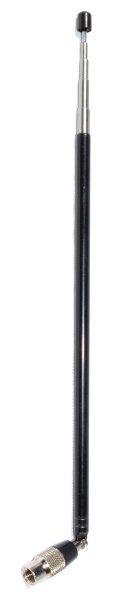
The ANT500 ships with retail HackRF kits. It is a 75 cm telescoping whip with an SMA male connector. Specs:
- Frequency range: 75 MHz – 1 GHz primary; usable but inefficient outside this range.
- VSWR: < 2.5 across primary range.
- Gain: ~0 dBi (omnidirectional, vertically polarised).
For sub-1-GHz sub-GHz remote-control work, FM broadcast survey, and casual airband listening, ANT500 is sufficient. Nothing more is needed.
8.3.2 Higher-band — ANT700
For 400 MHz – 7.2 GHz work — most importantly the 2.4 GHz ISM band (WiFi, BLE, ZigBee), the 5.x GHz WiFi bands, and high-band TPMS — the ANT700 is the matching telescoping whip:
- Frequency range: 400 MHz – 7.2 GHz.
- VSWR: < 2.5.
- Gain: ~0 dBi.
ANT700 + ANT500 covers basically the entire HackRF One operating range with telescoping whips that fit in a backpack. This is the minimum sensible “field bag” antenna kit.
8.3.3 Discone
For wide-band receive that can’t be served by switching whips, a discone antenna (Diamond D130, MFJ-1868, or build-your-own from coat hangers) is the right answer:
- Frequency range: 25 MHz – 1.3 GHz.
- Gain: ~0 dBi.
- VSWR: < 1.5 across most of the range.
- Mounting: outdoor mast typical; permanent installation.
A discone won’t cover 2.4 GHz cleanly but is the gold standard for sub-1.3-GHz monitoring. Permanent-station HackRF setups usually feed from a discone.
8.3.4 Yagi (directional)
For finding a specific signal source (direction-finding, weak-signal pulls), a Yagi-Uda array gives 8–14 dBi forward gain at the cost of being directional and band-specific:
- Common forms: 2-m ham band (144 MHz) Yagi, 70-cm (430 MHz) Yagi, 1.2 GHz Yagi.
- Useful for: tracking a transmitter (rotate the Yagi for peak signal), pulling a weak distant station, directional surveys.
8.3.5 Active loop / mag loop
For HF reception (below 30 MHz) a magnetic loop antenna is the small-form-factor answer:
- Wellbrook ALA1530 ($300+) — premium, very low noise.
- MLA-30+ ($60) — cheaper, more typical noise.
- NooElec mag-loop kit ($90) — middle ground.
Loops are noise-cancelling by design, ideal for indoor reception where electrical noise dominates a vertical antenna’s noise figure. The HackRF One requires a Ham-It-Up upconverter to reach below 1 MHz; the HackRF Pro’s 100 kHz lower limit pairs with mag loops directly.
8.3.6 Dipole and quarter-wave
Cheap and effective when band-specific:
- Quarter-wave whip at 433 MHz: 17.3 cm of wire on an SMA socket. About $5 in parts. Resonance at the design frequency; <2 VSWR within ±5%.
- Dipole at 433 MHz: two 17.3 cm wires, total length 34.6 cm. Slightly more gain than the whip; needs a ground-plane-free environment.
When you know the band you care about, a tuned quarter-wave or dipole outperforms a wideband whip every time.
8.4 LNAs
8.4.1 When you need one
Add an LNA when the signal of interest is below the HackRF’s effective sensitivity floor. Calculate:
HackRF noise floor ≈ -174 dBm/Hz (kTB) + 10 log10(BW Hz) + NF
                    = -174 + 10 log10(2e6) + ~5 dB NF
                    = -174 + 63 + 5
                    = -106 dBm
So at 2 MHz bandwidth and 5 dB NF (HackRF One typical), the noise floor is ~ -106 dBm. Signals at -100 dBm are 6 dB above noise — usable. Signals at -110 dBm are below noise — need help.
An LNA with 2 dB NF (low-noise) replaces the system NF with that of the LNA (the Friis equation — at high LNA gain, the LNA’s NF dominates). So the new noise floor is:
≈ -174 + 63 + 2 = -109 dBmThree dB improvement is significant — it doubles the practical receive distance. With 30 dB of LNA gain, you also get margin against cable losses and against quiet-receiver mismatches.
8.4.2 Common LNAs paired with HackRF
Table 2 — 4.2 Common LNAs paired with HackRF
| Part / vendor | Gain | NF | Frequency | Bias | Price | Notes |
|---|---|---|---|---|---|---|
| Mini-Circuits ZRL-1150LN+ | 30 dB | 1.0 dB | 50–1000 MHz | external 12 V | $90 | Excellent for sub-GHz work |
| Mini-Circuits ZX60-P162LN+ | 22 dB | 0.6 dB | 50–6000 MHz | external 5 V | $80 | Wide-band, very low NF |
| NooElec SAWbird+ NOAA | 32 dB | 0.6 dB | 137 MHz only | bias-T 4.5 V | $40 | Filtered — for NOAA APT reception |
| NooElec SAWbird+ ADS-B | 31 dB | 0.4 dB | 1090 MHz only | bias-T 4.5 V | $40 | Filtered — for ADS-B reception |
| LNA4ALL (Adam-9A4QV) | 22 dB | 0.7 dB | 28 MHz – 2.5 GHz | external 5 V | $40 | Bench LNA; many on-line reviews |
| Avago / Broadcom MGA-62563 (MMIC) | 12 dB | 1.2 dB | DC – 6 GHz | 3.3 V | $5 | DIY board level |
The HackRF One’s bias-T can power most “bias-T compatible” LNAs (NooElec SAWbird family) directly off the SMA — hackrf_transfer -p 1 or the equivalent hackrf_set_antenna_enable(true) in code. For LNAs that need an external supply, a Mini-Circuits 12 V wall wart or bench supply does the job.
8.4.3 Cascaded LNAs
Two LNAs in series add gains but multiply noise figures via Friis. The first LNA dominates noise: a 30 dB / 1 dB LNA followed by a 30 dB / 5 dB LNA gives system NF ≈ 1 dB (not 6 dB). This is why putting the lowest-NF amplifier closest to the antenna matters.
Cascaded LNAs without a band-pass filter between them is a recipe for overload. The second LNA amplifies the first’s amplified out-of-band garbage, and you get strong-signal saturation. Filter between LNAs.
8.5 Filters
The HackRF’s 8-bit ADC is dynamic-range-limited, and strong out-of-band signals desensitise the in-band signal of interest. Filters fix this.
8.5.1 SAW filters
Surface-acoustic-wave filters give sharp band-pass response:
Table 3 — Surface-acoustic-wave filters give sharp band-pass response
| Filter | Centre freq | Bandwidth | Insertion loss | Vendor |
|---|---|---|---|---|
| TA0394A (433 MHz ISM) | 433.92 MHz | 1.7 MHz | 1.5 dB | Murata |
| TA0395A (868 MHz ISM) | 868.95 MHz | 1.5 MHz | 1.8 dB | Murata |
| TA0397A (915 MHz ISM) | 915 MHz | 28 MHz | 1.2 dB | Murata |
| Various 2.4 GHz ISM SAW | 2.45 GHz | 80 MHz | 1.5 dB | Murata, EPCOS |
NooElec sells SAW filters mounted on a small SMA-male/female PCB for $20–30; this is the easy route. DIY at the breadboard is harder than it sounds — SAWs need impedance-matched RF layout.
8.5.2 LC band-pass filters
For frequencies below 100 MHz where SAWs don’t work, hand-rolled LC ladders are the answer. Mini-Circuits sells modular SMA-mounted LC band-pass filters from $40 each.
8.5.3 Notch filters
To reject a specific strong interferer (e.g. an FM broadcast station that’s saturating the chain when you’re trying to receive at 100 MHz nearby), a notch filter — narrow stop-band at the interferer frequency, pass elsewhere — is the right answer.
8.5.4 The Ham-It-Up upconverter
For HF (below 1 MHz on HackRF One), the NooElec Ham It Up upconverter shifts the entire 0–30 MHz HF band up to 125–155 MHz where the HackRF can see it:
[HF antenna] ─► [Ham-It-Up converter] ─► [HackRF]
                  (mixer at 125 MHz)
The HackRF tunes to e.g. 125 MHz + (frequency of interest); receiver software offsets the displayed frequency to compensate. Works well; introduces ~6 dB of mixer noise; better than nothing for HF on a HackRF One. The HackRF Pro renders this unnecessary (Vol 1 §5).
8.6 Attenuators
Sometimes the signal is too strong — a HackRF directly connected to a transmitter under test, or an antenna in front of a 50 W ham radio. SMA attenuators in 3 / 6 / 10 / 20 / 30 dB values let you knock the signal down. Mini-Circuits sells matched-pair attenuators in any sane value; expect $15–25 each.
A 0–60 dB step attenuator ($150–300) is a useful bench tool — bring the signal down to a level where the HackRF’s gain control can do its work properly.
8.7 The 8-bit ADC Dynamic-Range Budget
The HackRF One’s 8-bit ADC gives ~50 dB of in-band dynamic range (Vol 2 §9). This is the fundamental limit. Working within it:
Table 4 — The HackRF One's 8-bit ADC gives ~50 dB of in-band dynamic range ([Vol 2 §9](/hackrf-one/vol-2/#29-the-adcdac--maxim-max5864)). This is the fundamental limit. Working within it
| Strong signal in band | What happens | Mitigation |
|---|---|---|
| > -10 dBm at SMA | ADC clipping; harmonic distortion; sample drops | Reduce gain (-l, -g); consider attenuator |
| -10 to -20 dBm | Near saturation; nonlinearity creeps in | Reduce LNA gain |
| -20 to -50 dBm | Strong but in-range | OK; you’re in the dynamic-range budget |
| -50 to -90 dBm | Mid-range | OK |
| -90 to -110 dBm | Near noise floor | Boost gain; consider external LNA |
| < -110 dBm | Below noise floor | Definitely needs LNA + low-NF chain |
The 50 dB budget is what’s available for the gap between strongest and weakest signal in your captured band. If you’re looking for a -100 dBm weak signal in the same MHz as a -50 dBm strong signal, you’re outside the budget — the strong signal will desensitise.
This is why band-selective antennas, pre-LNA filters, and post-LNA filters earn their cost — they remove the strong out-of-band signals that would otherwise eat the dynamic-range budget.
For 12-bit-class dynamic range work (HF DXing, weak-signal modes, dense urban environment), the HackRF is the wrong tool — Airspy HF+ Discovery (24-bit ADC) or SDRplay RSPdx (14-bit ADC) is the right one. The HackRF wins on frequency range and transmit capability, not on dynamic range.
8.8 Bench-Test Antenna and Front-End
A useful bench setup:
[signal generator] ─► [step attenuator] ─► [HackRF]
                       0–60 dB
Drives a known signal at known power into the HackRF. With this setup you can:
- Measure HackRF’s actual sensitivity at any frequency.
- Verify the LNA gain you measured against the LNA’s spec.
- Calibrate the gain values your software claims vs measured signal level.
- Verify the dynamic range: drive with a strong signal, drop the attenuator until the strong signal masks a small one nearby.
A used HP 8657B or HP 8665A signal generator runs $300–600 on eBay and outputs to about 1.05 GHz (8657) or 4.2 GHz (8665) — extends the calibration range to most of where you’ll use the HackRF.
8.9 Cheatsheet Updates from this Volume
For Vol 12:
- Default field kit: ANT500 (sub-1 GHz) + ANT700 (1–7 GHz)
- For HF: Ham-It-Up upconverter (HackRF One); HackRF Pro sees HF directly
- LNA noise floor: -174 + 10log(BW) + NF (dBm)
- HackRF One NF ~5 dB without external LNA; ~2 dB with quality LNA in front
- Always filter between cascaded LNAs to prevent overload
- Bias-T: enable with
-p 1onhackrf_transfer; max 5 V / ~50 mA - Step attenuator on bench: 0–60 dB sweet spot
- 8-bit dynamic range: ~50 dB; plan accordingly
8.10 Resources
Table 5 — 10. Resources
| Resource | URL |
|---|---|
| Mini-Circuits LNAs | https://www.minicircuits.com/ |
| NooElec SAWbird + LNA combos | https://www.nooelec.com/store/sawbird.html |
| NooElec Ham It Up upconverter | https://www.nooelec.com/store/ham-it-up.html |
| LNA4ALL | https://lna4all.blogspot.com/ |
| Diamond D130 discone (datasheet) | https://www.diamondantenna.net/d130nj.html |
| Wellbrook mag loops | https://www.wellbrook.uk.com/ |
| Murata RF SAW filter catalogue | https://www.murata.com/products/rffilter |
| Friis transmission equation reference | https://en.wikipedia.org/wiki/Friis_formulas_for_noise |
| GSG ANT500 reference | https://greatscottgadgets.com/ant500/ |
Comments (0)