Wi-Fi Pineapple · Volume 14
Hak5 WiFi Pineapple Volume 14 — Enterprise: Hardware & Electronics
The rack-mount platform — quad-core ARM, a five-radio MIMO array, gigabit ethernet, and the scale-up design
14.1 About this volume
The Enterprise is the WiFi Pineapple scaled up into a rack-mount, AC-powered, permanently-deployable platform. Where the Mark VII is a puck (Vol 9) and the Pager fits a pocket (Vol 12), the Enterprise is infrastructure — a quad-core ARM compute platform driving a five-radio dual-band MIMO array, built for agencies, large-scale assessments, and permanent deployments. This volume is the hardware treatment; Vol 15 covers multi-radio operation, firmware, scale, and mods.
Vol 7 (the generic hardware architecture) is the pattern; the Enterprise is its most-radios, most-compute, most-power instance. Everything Vol 7 says about role-based radios and the networking-SoC pattern is true here — just at five radios and a quad-core ARM instead of three radios and a single MIPS core. Research-baseline applies.
14.2 The Enterprise at a glance
┌─ WiFi Pineapple Enterprise ────────────────────────────────┐
│ CPU        717 MHz · 4× ARM Cortex-A7 quad-core            │
│ Memory     1 GB DDR3L RAM · 4 GB eMMC                      │
│ Radios     5 dual-band MIMO · 802.11ac Wave 2 · MU-MIMO    │
│            Radio 0/1  Qualcomm IPQ4019  (2.4/5) 1.733 Gbps │
│            Radio 2/3/4 MediaTek MT7612U (2.4/5) 866 Mbps   │
│ Net        2× 1000BASE-T (1 GigE) RJ45 · USB-C 3.0 ethernet│
│ Power      100-240 V AC · 50/60 Hz                         │
│ Scale      ~100 DHCP clients                               │
│ Standards  802.11 ac Wave 2 / ac / a / b / g / n           │
│ Form       Rack-mount metal enclosure                      │
└────────────────────────────────────────────────────────────┘
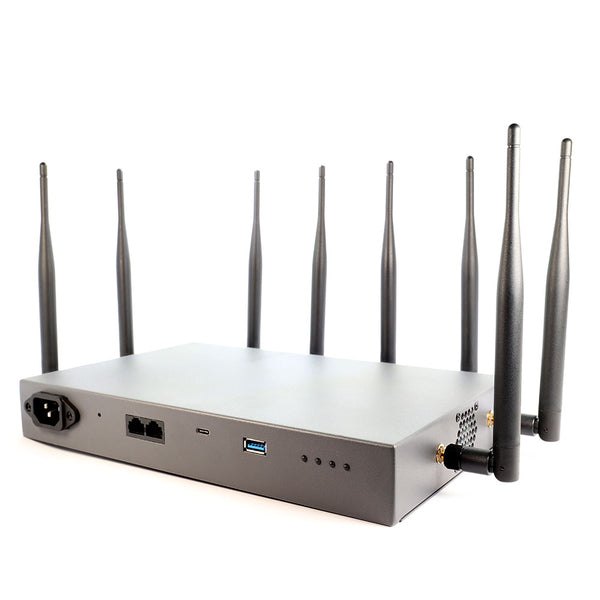
The Enterprise’s identity: it is a different deployment model, not a bigger Mark VII. Every spec in that box is a scale-up — five radios instead of three, a quad-core ARM instead of a single MIPS core, four times the RAM, gigabit ethernet ×2, mains power, a metal rack chassis. But the reason for every one of those is the same: the Enterprise is built to run many radios, against many clients, sustained, in a fixed install — and a puck cannot do that. Vol 16 frames the line as a matrix, not a ladder; the Enterprise is the clearest proof — it is not “the best Pineapple,” it is “the Pineapple for the deployment shape the others cannot serve.”
14.3 The quad-core ARM compute platform
The Enterprise is built on a 717 MHz quad-core ARM Cortex-A7 with 1 GB of DDR3L RAM and 4 GB of eMMC — a genuine multi-core compute platform, where the Mark VII is a single MIPS core (Vol 9 §3).
Why the Enterprise needs real compute — and the Mark VII does not:
   Mark VII compute vs Enterprise compute — why the gap
   ════════════════════════════════════════════════════════

   Mark VII: 1 MIPS core, 256 MB RAM
     drives 3 radios · 1 PineAP instance · modest client count
     → a single core keeps up (Vol 9 §3)

   Enterprise: 4 ARM Cortex-A7 cores, 1 GB RAM
     drives 5 radios · multiple concurrent PineAP/monitor
     roles · ~100 DHCP clients · sustained multi-hour runs ·
     fleet-scale Campaigns + Cloud C2
     → that is genuinely MORE WORK, concurrently, and it
       NEEDS the cores and the RAM to do it

   The compute scales because the JOB scales. Five radios
   doing five things at once, for a hundred clients, is not
   a single-core job.
What is still off-device, even here. The Vol 7 §7 principle — heavy compute is off-device — still holds for the Enterprise. Even with a quad-core ARM, the Enterprise does not crack handshakes (that is a GPU host’s job — Vol 19 §3); it does not replace the off-device analysis pipeline. The Enterprise’s extra compute is for concurrency and scale — running five radios and a hundred clients at once — not for becoming a number-crunching box. It is a bigger front end, not a back end.
The 1 GB of DDR3L is four times the Mark VII’s RAM, sized for the working set of five radios, multiple concurrent role instances, a larger recon/client-tracking state, and fleet-scale Campaign orchestration. The 4 GB eMMC matches the Pager’s and doubles the Mark VII’s — storage for the firmware, modules, Campaign definitions, and captures-in-progress at the Enterprise’s larger scale.
14.4 The five-radio MIMO array
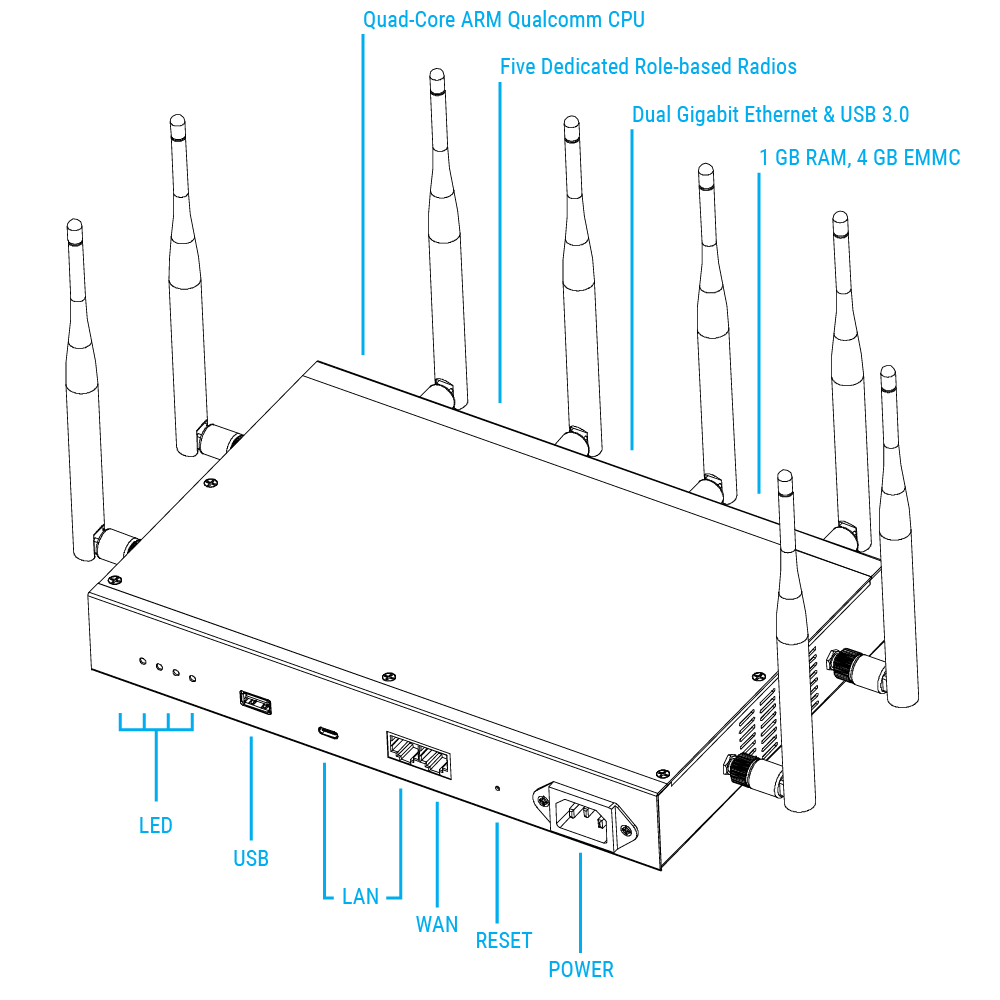
This is the Enterprise’s defining hardware feature, and the clearest scale-up in the line: five dual-band MIMO radios, on two chipsets:
Table 1 — This is the Enterprise's defining hardware feature, and the clearest scale-up in the line: five dual-band MIMO radios, on two chipsets
| Radios | Chipset | Bands | Peak rate |
|---|---|---|---|
| Radio 0/1 | Qualcomm IPQ4019 | 2.4 GHz / 5 GHz | 1.733 Gbps |
| Radio 2/3/4 | MediaTek MT7612U | 2.4 GHz / 5 GHz | 866 Mbps |
All five are dual-band (2.4 and 5 GHz — no MK7AC needed; the Enterprise is dual-band by construction), and the array supports 802.11ac Wave 2, MU-MIMO, and transmit beamforming.
   Why five radios — the role-based model at scale
   ════════════════════════════════════════════════════════

   Mark VII (3 radios):   1 mgmt · 1 PineAP · 1 monitor
                          → one of each. Serial-ish.

   Enterprise (5 radios): e.g. 1 mgmt
                               2 PineAP (different bands/chans)
                               2 monitor (different bands/chans)
                          → MULTIPLE of each, CONCURRENTLY.

   The role-based radio model (Vol 7 §3) says each radio
   gets a role. With FIVE radios the Enterprise can run
   MULTIPLE PineAP instances and MULTIPLE monitor instances
   AT ONCE — covering more bands, more channels, more of
   the airspace, simultaneously. This is the architectural
   reason the Enterprise SCALES (Vol 15 §4 is the operating
   treatment).
The two-chipset split is a capability-tiering within the array: the IPQ4019 pair are the high-throughput radios (1.733 Gbps — Qualcomm’s higher-end Wi-Fi SoC silicon); the MT7612U trio are the same MediaTek part the Mark VII’s MK7AC uses (Vol 11 §3), 866 Mbps each. Five radios, two performance tiers, all dual-band — the firmware (Vol 15 §3-4) assigns roles across the whole array. The exact per-radio role mapping is operator-configurable and a doc-audit detail; the architectural fact is fixed: five dual-band radios is enough to run multiple PineAP and multiple monitor roles concurrently, and that is what the Enterprise is for.
14.5 Networking — dual gigabit ethernet and USB-C 3.0
The Enterprise’s wired networking is a real scale-up: two 1000BASE-T (1 GigE) RJ45 ports plus a USB-C 3.0 ethernet interface (an ASIX USB 3.0 ethernet bridge).
   Why dual GbE matters for the Enterprise's job
   ════════════════════════════════════════════════════════

   The Enterprise is a FIXED-INSTALL device that integrates
   into REAL NETWORK INFRASTRUCTURE. Two gigabit ports let it:

     • one port = wired UPLINK (the Enterprise's path to the
       wider network / the internet / a Cloud C2 server)
     • one port = a SEGREGATED test network, or a management
       network kept separate from the uplink

     ...or fleet/management separation, or any two-network
     topology a permanent install needs.

   A puck on a USB-C tether (Mark VII) doesn't integrate into
   infrastructure like this. The Enterprise is built to be
   WIRED IN — and dual GbE is how.
The wired side is what supports the Enterprise’s scale-up operating model (Vol 15): a permanently-installed device, integrated into a network, reachable and manageable over real ethernet rather than a USB tether to a co-located laptop. The USB-C 3.0 ethernet interface adds a third network path. This is infrastructure-class networking — appropriate for a device that lives in a wiring closet, not a bag.
14.6 Power and the rack-mount enclosure
The Enterprise runs on 100-240 V AC mains, 50/60 Hz, in a rack-mountable metal enclosure.
This is the Enterprise’s most fundamental trade, and it is deliberate:
   The Enterprise's power/form trade
   ════════════════════════════════════════════════════════

   GIVES UP:   portability. No battery. No bag. No "walk in
               with it." It is mains-powered rack equipment.

   GETS:       • SUSTAINED operation — no battery clock. It
                 runs as long as it has power, indefinitely.
               • a real metal chassis — durable, rack-mount,
                 built for a permanent install
               • the power headroom for 5 radios + quad-core
                 ARM under sustained load (§8 — thermal)

   This is the RIGHT trade for the Enterprise's job
   (permanent install, large-scale, sustained — Vol 15 §5,
   §8) and the WRONG trade for the field — which is exactly
   why the line ALSO has the Pager and the Mark VII.
The metal rack-mount chassis is not cosmetic — it is the form factor of permanent infrastructure. An Enterprise goes in a rack, in a wiring closet, in a fixed monitoring position, and stays. The Mark VII’s puck and the Pager’s handheld are carried; the Enterprise’s chassis is installed. That single difference — installed vs carried — cascades into everything about how the Enterprise is operated (Vol 15 §2, §8).
14.7 Scale — ~100 DHCP clients
The headline scale figure: the Enterprise handles ~100 DHCP clients — against the Mark VII’s modest client count (a handful).
What that figure means operationally:
- Large-venue assessments. A conference, a corporate floor, a venue — environments with many devices in the airspace and potentially many clients to engage. The Mark VII’s client ceiling makes it a small-scope tool; the Enterprise’s ~100-client capacity makes large-venue work viable.
- Many concurrent associated clients. When PineAP is running and clients are associating (Vol 3 §6), the Enterprise can hold a hundred of them — issue DHCP, route their traffic, track them — concurrently. That is a memory, compute, and radio-count requirement all at once (§3, §4) — and it is why the Enterprise has the hardware it has.
   Why a puck tops out well below ~100 clients
   ════════════════════════════════════════════════════════

   A Mark VII would choke on ~100 clients because:
     • 1 MIPS core can't track/route/serve that many (§3)
     • 256 MB RAM can't hold the state (§3)
     • 3 radios can't cover the airspace breadth needed (§4)

   The Enterprise's quad-core ARM + 1 GB RAM + 5 radios is
   SIZED for exactly this number. The ~100-client figure
   isn't a feature bolted on — it's the SUM of the hardware
   scale-ups in §§3-4 expressed as a usable capacity.
The ~100-client number is the single best summary of why the Enterprise exists: there is a class of engagement — large, dense, sustained — that no puck can serve, and the Enterprise is the answer to it.
14.8 The board and thermal design
The Enterprise’s board drives five radios and a quad-core ARM, integrates dual GbE and a USB 3.0 ethernet bridge, and runs on mains power — a substantially more complex board than the Mark VII’s (Vol 9 §7).
Thermal design is a first-order concern here — and it is only a first-order concern on the Enterprise. The Mark VII (single MIPS core, three small radios, a plastic puck) and the Pager (low-power, pocket) run warm-not-hot. The Enterprise — five radios plus a quad-core ARM under sustained load — generates genuine, continuous heat, and it has to dissipate it for the indefinite runtime the device promises (§6). The metal rack-mount chassis is part of the thermal answer (metal dissipates; a plastic puck would not survive five radios under sustained load), and a permanent-install device in a rack has the environment (airflow, a controlled space) that a bag-carried puck does not.
The exact thermal design — whether active cooling, the airflow path, the chassis-as-heatsink details — is a doc-audit item against the actual unit. The architectural fact: thermal scales with radio count and compute, the Enterprise is the high end of both, and the metal rack chassis is the form factor that makes sustained five-radio operation thermally viable.
14.9 Resources
- WiFi Pineapple Enterprise docs: https://docs.hak5.org/wifi-pineapple-enterprise/
- WiFi Pineapple Enterprise product page: https://shop.hak5.org/products/wifi-pineapple-enterprise
- WiFi Pineapple Enterprise FAQ: https://shop.hak5.org/pages/wifi-pineapple-enterprise-faq
- Vol 7 — the generic hardware architecture this volume is the largest instance of
- Vol 9 — the Mark VII, for the compute/radio/form contrast
- Vol 15 — Enterprise firmware, multi-radio operation, scale, mods
- Vol 16 — model comparison
This is Volume 14 of a 21-volume series. Next: Vol 15 covers the Enterprise in operation — rack deployment, the firmware build, multi-radio role orchestration, operating at scale, Campaigns and Cloud C2 at fleet scale, mods, and the use cases where the Enterprise fits.
Comments (0)