Wi-Fi Pineapple · Volume 16
Hak5 WiFi Pineapple Volume 16 — Model Comparison & Which to Get First
The four current models side by side — the spec matrix, the capability deltas, the decision tree, and the acquisition order
16.1 About this volume
Vol 16 opens Phase 3 — the synthesis. It puts the four current models (the per-model deep dives, Vols 9-15) side by side and answers the question that started this whole deep dive: which one to get first, and in what order to acquire all four.
The framing, established in Vol 2 §8 and reinforced through every per-model volume: the current line is a matrix, not a ladder. The Enterprise is not “a better Mark VII” — it is a different deployment model (Vols 14-15). The Pager is not “a worse Mark VII” — it is a different form factor (Vols 12-13). Comparison has to be capability-and-fit, not a single ranking. This volume’s job is to make that matrix legible enough to decide on.
16.2 The full spec matrix
The four models, every axis, side by side (research-baseline — docs.hak5.org / shop.hak5.org):
Table 1 — The four models, every axis, side by side (research-baseline — docs.hak5.org / shop.hak5.org)
| Axis | Mark VII | Mark VII + AC Tactical | Pager | Enterprise |
|---|---|---|---|---|
| CPU / SoC | single-core MIPS | single-core MIPS (= Mark VII) | pocket SoC (dual-radio class) | 717 MHz quad-core ARM Cortex-A7 |
| RAM / storage | 256 MB / 2 GB | 256 MB / 2 GB | 256 MB / 4 GB | 1 GB DDR3L / 4 GB |
| Radios | 3 role-based | 3 + MK7AC adapter | dual-radio array | 5 dual-band MIMO |
| Bands | 2.4 GHz native | + 5 GHz / 802.11ac | 2.4 / 5 / 6 GHz + BT/BTLE | 2.4 / 5 GHz, 802.11ac Wave 2, MU-MIMO |
| Power | USB-C (+ power bank) | USB-C (+ power bank) | 2000 mAh integrated, ~4 h | 100-240 V AC mains |
| Display | none (web UI) | none (web UI) | ~2.4” color + buttons | none (web UI) |
| Feedback | 1 RGB LED | 1 RGB LED | 4× RGB LED, buzzer, vibration, RTC | (rack equipment) |
| Network | USB-C ethernet | USB-C ethernet | integrated ethernet adapter | 2× GbE RJ45 + USB-C 3.0 ethernet |
| Scale | small client count | small client count | small client count | ~100 DHCP clients |
| Form | small puck | puck + MK7AC, in a case | pocketable handheld | rack-mount metal chassis |
| Price (research) | (see shop.hak5.org) | ~$235 (kit) | (see shop.hak5.org) | (see shop.hak5.org) |
| Deep dive | Vols 9-10 | Vol 11 | Vols 12-13 | Vols 14-15 |
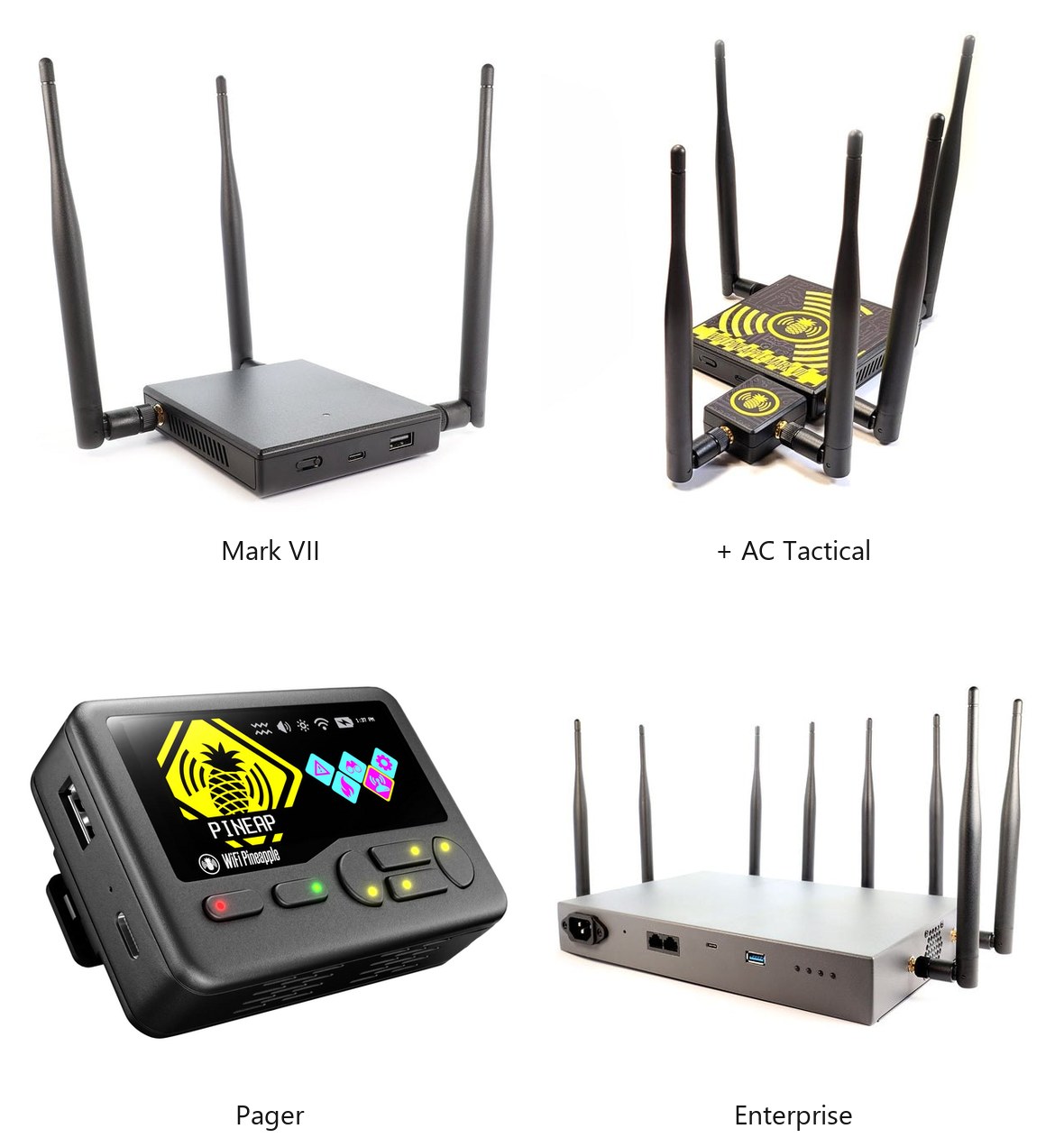
16.3 Capability deltas — what each model adds
Reading the matrix as deltas — what you gain moving from the baseline outward:
   The capability deltas, from the baseline
   ════════════════════════════════════════════════════════

   MARK VII = the platform.
     web UI, PineAP, Campaigns, 3 role-based radios, 2.4 GHz.
     Everything else is a delta FROM here.

   + AC TACTICAL  adds: 5 GHz / 802.11ac (the MK7AC) + a
                  field kit. The delta that makes the
                  baseline COMPLETE for modern Wi-Fi.

   PAGER          adds: portability + an on-device UI + an
                  integrated battery + a feedback subsystem
                  + Bluetooth + 6 GHz. The delta that makes
                  the platform a WALK-AROUND device.

   ENTERPRISE     adds: 5 radios + quad-core ARM + ~100-client
                  scale + mains-powered sustained operation +
                  a rack form factor. The delta that makes
                  the platform SCALE.
Each delta maps to a use case (Vols 10 §8, 11 §7, 13 §8, 15 §8):
Table 2 — Each delta maps to a use case ([Vols 10 §8](/wifi-pineapple/vol-10/#108-use-cases--where-the-mark-vii-fits), 11 §7, 13 §8, 15 §8)
| Delta | The use case it unlocks |
|---|---|
| Mark VII baseline | learning the platform; standard scoped pentests; the reference |
| + AC Tactical (5 GHz + kit) | the same engagements, against modern (5 GHz) Wi-Fi, field-ready |
| Pager (portability + BT + 6 GHz) | walk-around, opportunistic, short-window, BT-inclusive engagements |
| Enterprise (radios + scale + sustained) | agency-scale, large-venue, permanent-monitoring deployments |
The key insight: the deltas are not cumulative on one device. You do not “upgrade” a Mark VII into a Pager into an Enterprise. Each is a different device for a different shape of job — which is §4’s whole point.
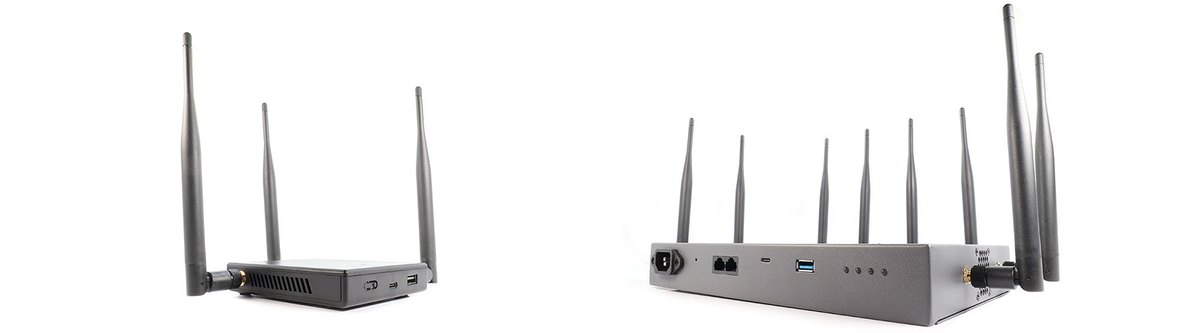
16.4 Form factor and power — the deployment axis
There is a second axis, orthogonal to capability, and it is often the real decision driver: how and where you deploy the device.
   The two axes of the matrix
   ════════════════════════════════════════════════════════

   CAPABILITY axis (§3): bands, radios, scale, BT...
   DEPLOYMENT axis (this section): how/where it physically goes

   DEPLOYMENT axis:
     TETHERED PUCK ────── Mark VII — runs from a laptop, in a bag
     FIELD KIT ────────── + AC Tactical — puck + kit + power bank,
                          deployable from a case
     POCKET / WALK ────── Pager — in your hand, on battery, moving
     RACK INSTALL ─────── Enterprise — wired into infrastructure,
                          mains-powered, permanent, does not move

   Many "which model" decisions are decided HERE, not on the
   capability axis. "Can I carry it? Does it need to move?
   Does it stay?" often answers the question before bands
   and radio counts even come up.
The deployment axis is why the matrix is a matrix. A job that needs 5 GHz and must be carried walk-around is a Pager job (Pager has 5 GHz and the form factor) — not a Mark VII + AC job, even though the Mark VII + AC also has 5 GHz, because the Mark VII + AC is not a walk-around device. Capability tells you what the device can do; deployment tells you whether it can do it where you need it done. You need both axes to pick correctly — which is what §5’s decision tree encodes.
16.5 The decision tree
The full decision tree, both axes (the fast version was Vol 1 §6; this is the Phase-3 version with the per-model picture behind it):
   START: which WiFi Pineapple for this job?
   │
   ├─ Is this LEARNING the platform, or a STANDARD scoped pentest?
   │     └─► MARK VII + AC TACTICAL.
   │         The baseline (skills transfer everywhere) + 5 GHz
   │         (no capability hole) + the field kit. (Vol 11)
   │
   ├─ Does the job need to be done WALK-AROUND / MOBILE / in-hand
   │  — or need BLUETOOTH or 6 GHz?
   │     └─► PAGER.
   │         On-device UI, battery, BT/BTLE, 6 GHz, feedback
   │         subsystem. The ~4 h battery is the constraint.
   │         (Vols 12-13)
   │
   ├─ Is this LARGE-SCALE (~100 clients / a venue), PERMANENT,
   │  SUSTAINED (days), or a FLEET / agency deployment?
   │     └─► ENTERPRISE.
   │         5 radios, quad-core ARM, mains power, rack form,
   │         Cloud-C2-native. (Vols 14-15)
   │
   └─ Just need 2.4 GHz and already own a Mark VII?
         └─► the bare MARK VII works — but add the MK7AC.
             A Mark VII without 5 GHz has a known hole. (Vol 11)
Two override-style rules sit on top, from the deployment axis (§4):
- “It must move / be carried in-hand” forces the Pager — nothing else is a walk-around device.
- “It must be a permanent fixed install at scale” forces the Enterprise — nothing else is rack infrastructure.
If neither override applies, the job is a Mark VII + AC Tactical job — which is why that bundle is both the recommended first buy (§6) and the most common answer to “which Pineapple.”
16.6 Which to get first
The recommendation: the Mark VII + AC Tactical kit. This is the Vol 1 / Vol 11 §7 recommendation, defended here against the full four-model picture:
   Why Mark VII + AC Tactical is the first buy
   ════════════════════════════════════════════════════════

   1. IT IS THE BASELINE. Everything you learn — the web UI,
      PineAP, Campaigns, the operating model — transfers to
      the Pager and Enterprise, because they run the same
      firmware family (Vols 13, 15). Learn on the thing the
      line is built on, not on a specialisation of it.

   2. THE MK7AC CLOSES THE 5 GHz HOLE. The bare Mark VII is
      2.4 GHz native; modern targets are on 5 GHz. The +AC
      kit includes the fix (Vol 11 §3) — same destination as
      "bare Mark VII + buy the MK7AC later," bundled.

   3. THE TACTICAL KIT MAKES IT DEPLOYABLE. Case, field
      guide, battery-pack pairing (Vol 11 §5) — a field tool,
      not a bench tool.

   4. THE PRICE (~$235) IS THE COST-EFFECTIVE ENTRY POINT
      for baseline + 5 GHz + field kit.
Why not start with the Pager or the Enterprise: both are specialisations (§3-4). The Pager is form-factor-specific (walk-around); the Enterprise is scale-specific (permanent, large). Starting on a specialisation means learning a narrowed version of the platform first and back-filling the baseline later — backwards. The Mark VII + AC is the general device; learn the platform there, then add the specialisations as the work demands them.
The honest caveat: if a buyer’s only foreseeable use is, specifically, walk-around BT recon — then yes, start with a Pager. The recommendation is for the general case: “acquire one of each, but which first” → the baseline first.
16.7 The acquisition order for all four
For a plan to acquire one of each model, the recommended order, with the reasoning:
   The four-model acquisition order
   ════════════════════════════════════════════════════════

   1st  MARK VII + AC TACTICAL  — learn the platform on the
        baseline; get 5 GHz from the start; a deployable
        field kit. Everything else builds on the fluency
        this buys. (Vol 11 §7, §6 above)

   2nd  PAGER  — once the platform is familiar, the Pager
        is the portability/BT/6 GHz complement. Buying it
        second means you bring PLATFORM FLUENCY to a
        SPECIALISED form factor — the right way round.
        (Vols 12-13)

   3rd  ENTERPRISE  — the scale platform. Buy it when there
        is a deployment that actually NEEDS ~100-client,
        five-radio, permanent-install capacity. Until then
        it is expensive rack equipment sitting idle. Let
        the NEED pull this purchase. (Vols 14-15)

   (the bare MARK VII is essentially SUBSUMED by the +AC kit
    — there is no separate "buy the bare Mark VII" step;
    the kit IS the Mark VII, completed.)
The principle behind the order: buy the general before the specialised, and let need pull the expensive specialisation. The Mark VII + AC is bought to learn and to use generally; the Pager is bought to add a form factor once the platform is known; the Enterprise is bought when a specific large/permanent deployment justifies it. Buying the Enterprise first would mean owning rack infrastructure before having the platform fluency or the deployment to use it on — capital ahead of need.
This order is a recommendation, not a rule — if a specific engagement lands that needs the Enterprise before the Pager, the need reorders the list. But absent a need pulling it forward, general-before-specialised, baseline-first, is the order.
16.8 Resources
- Hak5 shop — all models: https://shop.hak5.org/products/wifi-pineapple
- WiFi Pineapple Mark VII compare: https://shop.hak5.org/pages/wifi-pineapple-mark-vii-compare
- Vols 9-15 — the per-model deep dives this volume synthesises
- Vol 1 §6 — the preliminary fast decision tree
- Vol 17 — the per-use-case setup playbooks (the “now that you’ve picked, how do you set it up”)
../_shared/comparison.md— the cross-tool decision matrix · the capability matrix
This is Volume 16 of a 21-volume series. Next: Vol 17 — Setup Playbooks by Use Case: wardriving, penetration testing, red-team, blue-team attack-watching, and lab/learning — how to set up each model for each job.
Comments (0)