Wi-Fi Pineapple · Volume 17
Hak5 WiFi Pineapple Volume 17 — Setup Playbooks by Use Case
Wardriving, penetration testing, red-team, blue-team attack-watching — how to set up each model for each job
17.1 About this volume
Vol 17 is the operational synthesis — for each major use case (wardriving, pentesting, attack-watching, red-team, and lab), a setup playbook: which model, which radio-role assignment, which PineAP config, which modules, which posture controls. Each playbook is bound to Vols 4 + 8 — the authorization gate is step zero of every active playbook, and that is not boilerplate; it is the difference between a professional engagement and a crime (Vol 4 §9).
Templates land in 04-templates/ (wardrive, pentest, attack-watch) — this volume is the narrative; the templates are the fill-in-the-blanks artifacts. Each playbook below uses a common shape: objective → model → radios → PineAP → modules → posture → closeout.
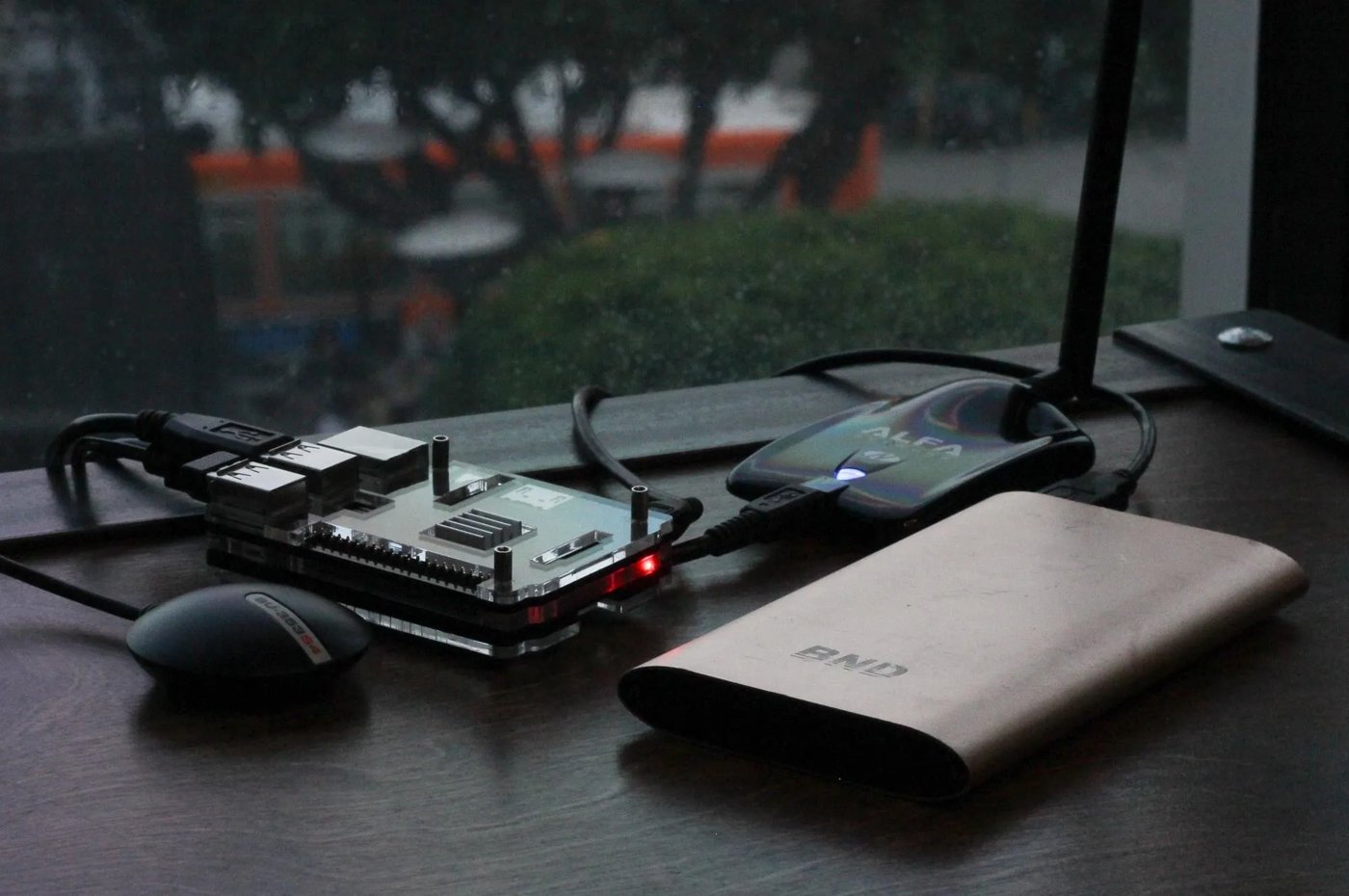
17.2 Playbook: wardriving / recon mapping
Objective: map the wireless environment — APs, clients, signal, channels, geography. Build a picture, not an intrusion.
Posture: this is the playbook with the lightest authorization friction — wardriving as passive recon sits on the lawful side of the Vol 4 legal-line diagram. The discipline is staying passive: logging only, no TX.
   Wardriving setup
   ════════════════════════════════════════════════════════

   MODEL    Pager (walk-around, on-device, battery — Vols 12-13)
            OR Mark VII + AC (vehicle, tethered to a laptop +
            power bank — Vol 11)

   RADIOS   ALL MONITOR. No PineAP radio active. The whole
            point is to LISTEN, not transmit.

   PineAP   logging only — Log Probes, Log Associations,
            Recon (Vol 3 §4-5). PineAP DAEMON OFF. No beacon
            response, no SSID pool broadcast, no deauth.

   MODULES  recon visualisation; GPS integration for the
            mapping (a GPS source tags the recon data with
            location).

   POSTURE  this is PASSIVE — generally lawful as recon
            (Vol 4). The discipline: do not let it drift
            active. The moment a PineAP TX feature is on, you
            are off the wardriving playbook and onto §3-4's.

   CLOSEOUT export the recon/mapping data; §7.
Why the Pager shines here: the walk-around form factor (Vol 13 §5) is wardriving-on-foot, and the feedback subsystem (Vol 12 §7) alerts you without a screen-watch. Why the Mark VII + AC for vehicle wardriving: tethered to a laptop in a vehicle, on a power bank, with the MK7AC giving 5 GHz coverage — the classic drive-and-map setup.
17.3 Playbook: penetration testing (scoped engagement)
Objective: the canonical authorized engagement — test a defined target’s wireless security and produce a reportable result.
   Penetration testing setup
   ════════════════════════════════════════════════════════

   STEP ZERO  THE AUTHORIZATION ARTIFACT (Vol 8 §2). In hand.
              Scope confirmed. This is not optional and it is
              not boilerplate — it is what makes everything
              below lawful (Vol 4 §9).

   MODEL      Mark VII + AC Tactical (Vol 11) — the baseline,
              field-ready, full 2.4/5 GHz. The default pentest
              Pineapple.

   RADIOS     management + PineAP + monitor (Vol 9 §4); the
              MK7AC adds the 5 GHz monitor/inject radio
              (Vol 11 §4).

   PineAP     the full engine — Allow Associations, the
              daemon, Beacon Response, the SSID pool — BUT
              SCOPED. Source/Target MAC targeting (Vol 3 §8)
              so PineAP engages ONLY the authorized target
              client(s), not the whole airspace. Scope
              discipline (Vol 8 §3) is built into the config.

   WORKFLOW   the Vol 10 §5 operating instructions: recon
              sweep → scoped PineAP test → handshake capture
              → crack OFF-DEVICE (Vol 19 §3) → Campaign run
              for the reportable audit (Vol 5 §4).

   MODULES    attack-workflow modules, evil-portal page sets
              (if in scope), reporting/export tooling — all
              vetted (Vol 6 §8, Vol 18 §8).

   POSTURE    every active step is inside the authorization
              artifact. Targeting scopes it. The Management
              UI Firewall is on (Vol 6 §8).

   CLOSEOUT   the full Vol 8 §9 / Vol 20 §8 closeout: stop
              TX, secure captures, restore state, write the
              report (incl. which controls would have stopped
              each technique — Vol 20 §8). §7 below.
This playbook is where the most of the deep dive comes together — Vol 3’s techniques, Vol 8’s posture, Vol 10’s operating instructions, Vol 19’s analysis pipeline. The Campaign run (Vol 5 §4) is what turns it into a deliverable.
17.4 Playbook: red-team operation
Objective: a covert, objective-driven operation — get to a defined goal, quietly, as an adversary would.
   Red-team setup
   ════════════════════════════════════════════════════════

   STEP ZERO  AUTHORIZATION ARTIFACT (Vol 8 §2) — covering
              the COVERT methods and any planted devices.
              Covert ≠ unauthorized. The artifact is the
              difference (Vol 4 §9, Vol 20 §7).

   MODEL      Pager (covert carry — Vols 12-13) for an
              operator-carried device; OR a planted Mark VII
              for a left-behind device.

   RADIOS     scoped to the objective — minimal footprint.
              A red-team op runs the LEAST it needs to, not
              the most it can.

   PineAP     tightly scoped — Source/Target MAC targeting
              (Vol 3 §8) at its strictest. Engage the
              objective's target(s), nothing else.

   C2         Cloud C2 (Vol 5 §5, Vol 19 §5) for remote
              operation of a planted device — with the
              attack-surface caveat (a planted, C2-reachable
              Pineapple is a standing remote-access surface;
              Vol 20 §6).

   POSTURE    DETECTION MANAGEMENT is the red-team-specific
              discipline. The Pineapple is LOUD (Vol 8 §6,
              Vol 20 §3) — a red team has to ACCOUNT for
              being detectable: minimal TX, minimal time,
              tight RF discipline, and a plan for when
              (not if) the activity is noticed.

   CLOSEOUT   retrieve every planted device; restore state;
              the discovery-and-response plan was ready
              before you started (Vol 20 §7).
The red-team-specific point: covertness is a posture, not a permission. A red-team op is still authorized work (the artifact covers the covert methods); it is just quiet authorized work. And the Pineapple’s loudness (Vol 20 §3) means red-team Pineapple work is always a race against detection — plan for it.
17.5 Playbook: blue-team attack-watching
Objective: the defensive use case — watch the airspace for other people’s attacks. Detect rogue APs, deauth floods, KARMA responders, other Pineapples (Vol 4 §6).
   Blue-team attack-watching setup
   ════════════════════════════════════════════════════════

   MODEL      Enterprise (Vols 14-15) for a permanent,
              wide-coverage monitoring install; OR a
              Mark VII for a desk-based / smaller-area watch.

   RADIOS     ALL MONITOR. Every radio listening. On the
              Enterprise, that is up to five radios covering
              both bands, multiple channels, concurrently
              (Vol 15 §4) — wide airspace coverage.

   PineAP     OFF — or logging only. This is a PASSIVE
              posture. You are WATCHING, not transmitting.

   WHAT YOU   detecting OTHER attackers' signatures:
   WATCH FOR    • rogue APs / evil twins in your airspace
                • deauth floods (someone running Vol 3 §9
                  against your network)
                • KARMA responders (another Pineapple
                  answering your clients' probes — Vol 4 §6)
                • the Pineapple's own detection signatures
                  (Vol 8 §6, Vol 20 §3) — turned around to
                  RECOGNISE them in your airspace

   POSTURE    here is the key posture fact: a PASSIVE,
              ALL-MONITOR, no-TX blue-team watch sits on the
              LAWFUL side of the Vol 4 line — it is
              observation of YOUR OWN airspace. It does NOT
              need per-target authorization the way an active
              engagement does. That makes the blue-team
              playbook the one you can run with the least
              legal friction (alongside §2's wardriving).

   CLOSEOUT   the "captures" here are detection logs /
              alerts; §7 for handling.
Why the Enterprise for the permanent install: mains power + sustained operation + five radios = the device that sits in a rack and watches the airspace continuously and widely (Vol 15 §5, §8). Why the Mark VII for a desk watch: a Mark VII in monitor mode at a desk is a perfectly good smaller-area passive detector. The blue-team playbook is the defensive mirror of everything else in this volume — and the deep dive covers it because understanding the attack is how you detect it (Vol 8 §6).
17.6 Playbook: lab / learning
Objective: build PineAP fluency — safely, on owned hardware, before any real engagement.
   Lab / learning setup
   ════════════════════════════════════════════════════════

   MODEL      any — but the Mark VII + AC Tactical (the
              baseline — Vol 16 §6) is the one to learn ON,
              because skills transfer from the baseline.

   ENVIRONMENT  a FULLY-OWNED lab: your own APs, your own
              client devices. Everything you point the
              Pineapple at, you own.

   RADIOS     experiment freely — assign and reassign roles
              (Vol 9 §4), see what each does.

   PineAP     run the FULL engine — KARMA, the daemon, beacon
              response, the SSID pool, deauth, capture. In a
              fully-owned lab you can run ALL of Vol 3's
              catalog and watch it work.

   POSTURE    THE LAB IS THE SAFE-HARBOUR. Because every AP
              and every client is YOURS, every technique in
              Vol 3 is lawful here (Vol 4 — owned hardware).
              The lab is where you make every mistake, learn
              every feature, and break every assumption —
              BEFORE an engagement where the legal line is
              real.

   GOAL       fluency. By the time you run §3's pentest
              playbook for real, every PineAP control should
              be familiar from the lab.
This is the playbook every operator should run first — before §§2-5. The lab is where the platform is learned without consequence, because owned-hardware-pointed-at-owned-hardware is the one configuration where the entire technique catalog is unambiguously lawful (Vol 4). Build the lab; break things in it; then take the platform out.
17.7 Cross-playbook: capture handling and reporting
Common to every playbook above — the discipline for what you collect:
   Capture handling — every playbook
   ════════════════════════════════════════════════════════

   □ CAPTURE-DATA DISCIPLINE (Vol 8 §4) — captured data is
     sensitive. Handshakes, probe logs, association logs,
     PCAPs all contain real information about real people
     and networks. Know where it is; protect it.

   □ THE OFF-DEVICE PIPELINE (Vol 19) — captures move OFF
     the Pineapple for analysis. The Pineapple captures;
     your laptop and a GPU host analyse and crack. The
     Pineapple is not the analysis platform (Vol 7 §7).

   □ CAMPAIGNS REPORTS (Vol 5 §4) — the on-device summary;
     the host-side analysis is the depth.

   □ CHAIN OF CUSTODY — for a professional engagement, the
     captures are evidence in a report. Treat them with the
     handling a deliverable deserves.

   □ DESTRUCTION — captured data is destroyed per the
     authorization artifact's data-handling terms (Vol 8 §2,
     Vol 20 §8). Engagement over = data handled and gone on
     the agreed schedule.
The reporting half: for the active playbooks (§3-4), the deliverable is a report — and the most valuable thing in it, per Vol 20 §8, is which control would have stopped each technique. A pentest’s value to the client is the defensive insight, not the list of things that worked. Build the report from contemporaneous notes; the Campaign-generated summary is the skeleton, the analysis is the substance.
17.8 Resources
04-templates/— the wardrive / pentest / attack-watch templates (the fill-in-the-blanks artifacts)- Vols 9-15 — the per-model operating detail each playbook draws on
- Vol 3 — the technique catalog · Vols 4 + 8 — the legal line and posture every active playbook is bound by
- Vol 16 — model comparison (the “which model” each playbook calls)
- Vol 19 — the tooling and capture-analysis pipeline §7 references
- Vol 20 — operational posture in the field (the deep version of every playbook’s posture section)
../_shared/legal_ethics.md— the hub-wide lab-discipline rules
This is Volume 17 of a 21-volume series. Next: Vol 18 — the Mods catalog: Hak5 official add-ons and accessories, the community module landscape, antenna and battery and case mods, the OpenWrt layer, and the vetting discipline.
Comments (0)